
5 things necessary for an interview
Discover the 5 essentials for a successful interview-clear goals, strong preparation, effective communication, active listening, and impactful follow-up.
Table of Contents

Introduction
In today’s dynamic job market, a single interview can pivot the trajectory of a startup or define a candidate’s career path. Yet, despite its importance, the interview process is often approached with a mix of hope and anxiety rather than a structured methodology.
On professional networks, you'll find a recurring theme: many talented individuals and seasoned hiring managers express frustration with interviews that fail to accurately assess capability or convey role expectations.
The core issue isn't a lack of effort, but often a lack of a clear, shared framework for what makes an interview truly effective.
Whether you're a founder hiring your first engineer or a professional navigating a competitive landscape, treating an interview as a strategic, two-way conversation is non-negotiable.
This article synthesises practical research and established best practices into five essential pillars for a successful interview. We will move beyond generic advice to explore the integration of clear objectives, comprehensive preparation, effective communication, active listening, and a conclusive follow-up.
These elements, when executed thoughtfully, transform a high-stakes meeting into a productive dialogue, ensuring both parties can make an informed decision.
1. The Foundation: Establishing Clear Objectives

An interview without a clear objective is like a ship without a rudder-it moves, but with no certainty of its destination. This is the first and most critical step, applicable to both the interviewer and the candidate.
For the interviewer, the objective is to assess the candidate's skills, experience, and, crucially, their fit within the team and company culture. This goes beyond simply checking boxes on a job description.
It involves determining if the candidate can solve the specific challenges the role presents and contribute to the company's long-term goals. A clear objective might be:
"Determine the candidate's ability to lead a distributed team in optimising our backend API response times," rather than a vague "see if they are a good leader."
For the candidate, the objective is equally vital. Is the goal solely to secure a job offer? Or is it also to evaluate if the company's values align with your own, understand the team's dynamics, and gauge the potential for professional growth?
Walking in with this clarity allows you to steer the conversation, ensuring you gather the information necessary to make your own decision. As research indicates, understanding what you want to achieve is the cornerstone of a productive interaction.
Jugaad solutions rarely scale here; a structured intention is the bedrock of a meaningful outcome.
2. The Non-Negotiable: Rigorous Preparation
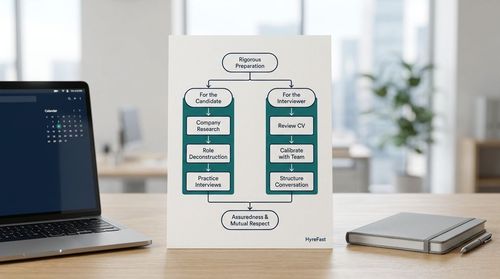
Preparation is the tangible manifestation of your objectives. It’s the work done behind the scenes that builds the confidence needed to perform under pressure. This pillar is the most frequently cited across all sources of interview advice, and for good reason. For the Candidate:
- Company Research: Go beyond the "About Us" page. Understand the company's products, recent news, competitors, and business model. For startups, this means understanding their funding stage, market differentiators, and technical stack. This knowledge allows you to tailor your responses and ask insightful questions.
- Role Deconstruction: Analyse the job description meticulously. Map your skills and achievements directly to the requirements. Prepare specific examples using the STAR method (Situation, Task, Action, Result) to demonstrate your competencies concretely.
- Practice, Don't Memorise: Rehearse answers to common questions, but focus on articulating your thought process. Technical candidates should be ready to walk through code or system design problems aloud, showcasing problem-solving skills, not just textbook answers.
For the Interviewer:
- Review the CV Deeply: Identify specific points for discussion-projects, career transitions, technical skills. Prepare questions that probe beneath the surface.
- Calibrate with the Team: Ensure all interviewers are aligned on the role's requirements and the criteria for evaluation. This avoids contradictory signals being sent to the candidate.
- Structure the Conversation: Have a plan for the interview flow-a warm-up, technical deep dives, behavioural questions, and a dedicated Q&A session for the candidate. A well-structured set of questions is essential for fairness and comprehensiveness.
Thorough preparation signals respect for the other party's time and transforms anxiety into assuredness.
3. The Conduit of Competence: Effective Communication

Effective communication is the channel through which your preparation and objectives are conveyed. It encompasses both verbal and non-verbal cues, creating a cohesive picture of your professional persona.
Verbal communication must be clear, concise, and confident. Avoid jargon unless it's context-appropriate, and explain complex concepts in simple terms.
This is especially important in technical roles, where the ability to explain a system to non-technical stakeholders is a prized skill. Modulate your tone of voice to convey enthusiasm and engagement.
Non-verbal communication-body language- often speaks louder than words. Positive body language includes maintaining good eye contact (or near-eye contact on video calls), sitting up straight to project attentiveness, and using open gestures.
For the interviewer, this means creating a welcoming atmosphere. For the candidate, it’s about demonstrating confidence and approachability.
A warm, genuine smile can ease tensions and build rapport. Remember, the interviewer is not just hiring a set of skills; they are hiring a colleague. Your professional appearance and demeanour are integral parts of this communication, forming that critical first impression.
4. The Art of Engagement: Active Listening
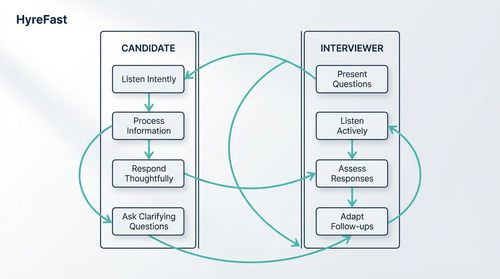
If communication is about output, active listening is about input. It is the skill of fully concentrating, understanding, and responding to what is being said, rather than passively hearing the message or, worse, simply planning your next response.
For the candidate, active listening means paying close attention to the interviewer's questions to ensure your answers are relevant. It involves picking up on subtle cues about the company's culture or the role's challenges.
When you listen actively, you can ask clarifying questions that demonstrate intellectual curiosity and a deep engagement with the discussion. For example, after describing a project, you might ask, "How does this approach align with the current direction of your engineering team?"
For the interviewer, active listening is the key to a fair assessment. It involves being present in the conversation, avoiding interruptions, and asking follow-up questions that dig deeper into the candidate's experiences.
Instead of moving rigidly down a list of questions, a skilled interviewer adapts based on the candidate's responses, exploring interesting avenues that reveal problem-solving abilities and cultural fit. Note-taking is a crucial tool here;
it aids focus and provides a factual record for post-interview evaluation, but it should not come at the expense of engagement.
Active listening transforms a transactional Q&A into a collaborative dialogue.
5. The Lasting Impression: The Follow-Up
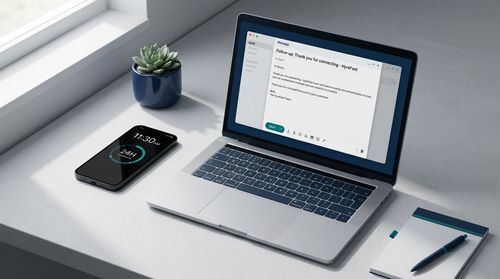
The interview's end is not the end of the process. The follow-up is a professional courtesy that reinforces your interest and leaves a final, positive impression. It is a simple yet powerful step that many neglect.
A timely follow-up, typically a personalised email sent within 24 hours, serves multiple purposes. It allows you to:
- Express gratitude for the opportunity and the interviewer's time.
- Reiterate your specific interest in the role, briefly connecting your skills to a point discussed during the interview.
- Address any minor points you felt you didn't articulate perfectly, offering concise clarification.
- Reaffirm your enthusiasm for the position.
This gesture demonstrates professionalism, attention to detail, and genuine interest. It keeps you top-of-mind as the hiring team makes its decision.
For the interviewer, acknowledging receipt of a thank-you note, while not always possible, is also a best practice that contributes to a positive candidate experience, regardless of the outcome.
Conclusions

- Framework Over Improvisation: A successful interview is a structured process built on clear objectives, not a free-form conversation. This framework ensures fairness and effectiveness for all parties.
- Preparation is Asymmetric Advantage: The depth of your research and practice directly correlates with your confidence and performance. It is the most controllable factor in the equation.
- Communication is a Two-Way Street: Effective interaction requires both articulate expression and genuine reception. Mastering both verbal and non-verbal cues is essential.
- The Dialogue is Key: Interviews are assessments, but they are also conversations. Active listening fosters a collaborative atmosphere that yields richer insights than a simple interrogation.
- The Close Matters: The follow-up is a critical component of the professional ritual, cementing your interest and leaving a polished, final impression.
Future Directions
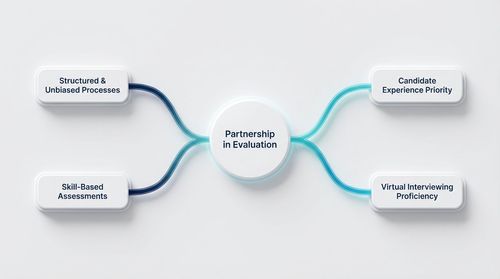
The future of interviewing is likely to see greater integration of technology, but the human elements outlined here will remain paramount.
- Structured & Unbiased Processes: Increased focus on standardised questions and scoring rubrics to minimise unconscious bias and create a more equitable process.
- Skill-Based Assessments: A move away from traditional CVs towards practical, hands-on assessments that better demonstrate a candidate's ability to perform in the role.
- Candidate Experience as a Priority: Companies will increasingly leverage feedback tools to refine their interview processes, recognising that a positive experience is crucial for employer branding.
- Virtual Interviewing Proficiency: As remote work persists, mastering the nuances of communication and engagement on digital platforms will become a fundamental skill for both interviewers and candidates.
Ultimately, an interview is a partnership in evaluation. By focusing on these five essential elements, you equip yourself not just to succeed, but to engage in a process that is respectful, insightful, and ultimately, more likely to lead to the right match.