
ATS vs AI Interview Screening: What’s Better for Fast-Growing Startups?
ATS vs AI interview screening: compare speed, bias control, and hiring quality to choose the best solution for fast-growing startups in 2025.
Table of Contents

Introduction
Hiring the right people quickly is one of the most critical challenges for any fast-growing startup. With limited resources and aggressive timelines, founders and talent leaders need tools that scale efficiently and make objective decisions.
Two commonly discussed options are Applicant Tracking Systems (ATS) and AI interview screening. While they sound similar, they operate at different stages of the hiring funnel and serve distinct purposes.
Many teams assume these tools are interchangeable, but understanding their unique strengths and limitations is key to building a hiring process that grows with your company.
This article breaks down the technical and practical differences between ATS and AI interview screening, evaluates their performance on efficiency, objectivity, and bias mitigation, and suggests how startups can adopt them thoughtfully.
We’ll cover how each system works, where they fit in your workflow, what trade-offs to expect, and what the future holds for AI-augmented hiring.
What an ATS Actually Does-And Where It Shines
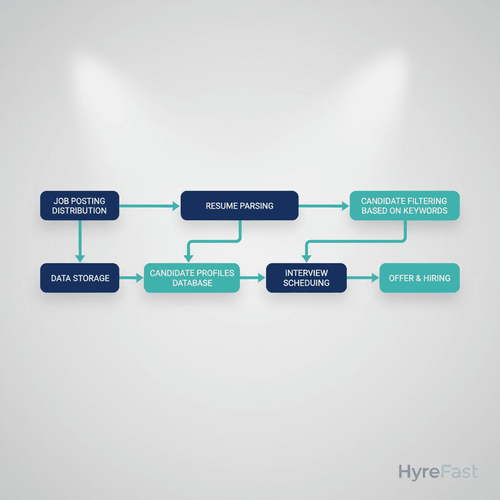
An Applicant Tracking System (ATS) is a software-based system that automates the process of reviewing and filtering job applications.
At its core, it’s a workflow and database tool designed to manage high-volume recruitment. When you’re scaling from 10 to 100 employees, an ATS helps you keep track of candidates, streamline communication, and reduce the manual effort of sorting resumes.
Key functions include job posting distribution, resume parsing, candidate data storage, and interview scheduling. For example, when you receive hundreds of applications for a software engineering role, the ATS can automatically filter candidates based on keywords, skills, or experience levels.
This is especially helpful for roles with clear, quantifiable requirements. It increases efficiency by reducing the time recruiters spend on initial screenings.
However, an ATS operates largely on rule-based or keyword-matching logic. It excels at handling structured data but may overlook nontraditional candidates or those with less standard resume formats.
For fast-growing startups that value potential over pedigree, this can be a limitation. Still, as a foundational tool for managing candidate pipelines, an ATS brings much-needed order to chaos.
How AI Interview Screening Adds Depth to Evaluations
AI interview screening uses artificial intelligence to analyze candidate responses to behavioral questions and assess their fit for the role.
Unlike an ATS, which filters resumes, this technology engages candidates directly-often through video or text-based interviews-and applies machine learning models to evaluate their answers.
These systems use natural language processing (NLP) and sometimes computer vision to gauge not just what candidates say, but how they say it.
They can assess clarity, confidence, empathy, or technical depth based on predefined rubrics. This approach provides more objective and consistent evaluations, reducing the variability that comes with human interviewers.
For instance, if you’re hiring for a customer success role, the AI can score candidates on communication skills and problem-solving abilities across thousands of data points.
One of the most promising aspects of AI screening is its potential for bias mitigation.
When designed with diverse training data and fairness-aware algorithms, these systems can minimize unconscious biases related to gender, accent, or background.
Research in generative AI and model explainability, such as work referenced in “Ultra Strong Machine Learning,” shows how transparency in AI decisions can further build trust in these tools.
Efficiency Gains: Automated Workflows vs. Intelligent Insights
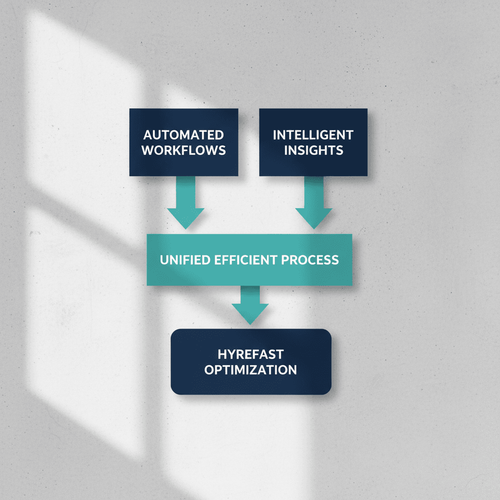
Both systems improve efficiency, but in different ways. An ATS streamlines the administrative side of hiring-posting jobs, sorting resumes, and scheduling interviews.
It’s a force multiplier for recruiters dealing with volume. AI interview screening, on the other hand, focuses on the evaluation step. It can analyze video responses in minutes, ranking candidates based on role-specific competencies.
In practice, AI screening often delivers deeper efficiency at the assessment stage. It doesn’t just filter candidates; it helps identify the best matches faster.
For roles where soft skills or cultural fit are important, this can significantly reduce time-to-hire.
However, AI systems may require more upfront configuration, including defining ideal response traits and training the model on what “good” looks like for your company.
Startups with high hiring volume and clearly defined role requirements might lean on ATS for scalability. Those prioritizing candidate quality and nuanced fit may find AI screening more impactful.
There’s also a middle path: using ATS for initial filtering and AI for shortlisted candidates, creating a layered, efficient process.
Objectivity and Bias Mitigation: Not All Systems Are Created Equal

Objectivity in hiring is about consistency and fairness. An ATS promotes objectivity by applying the same filters to every candidate-but those filters can inherit biases from the criteria they’re given.
If you keyword-match for degrees from top colleges, you might overlook talented innovators from less-known institutions.
AI interview screening, when thoughtfully built, can offer a more nuanced form of objectivity. By evaluating responses against predefined behavioral or competency frameworks, it reduces the subjectivity of human judgment.
Research into fragment descriptors and virtual screening methods highlights how AI can identify patterns and traits that humans might miss.
That said, AI systems aren’t automatically unbiased.
They reflect the data they’re trained on. If training data lacks diversity, the AI can perpetuate existing inequalities.
Continuous improvement and auditing-concepts highlighted in recent machine learning literature-are essential. Startups should look for systems that disclose their fairness measures and allow for human oversight.
Why a Hybrid Approach May Be the Smartest Choice
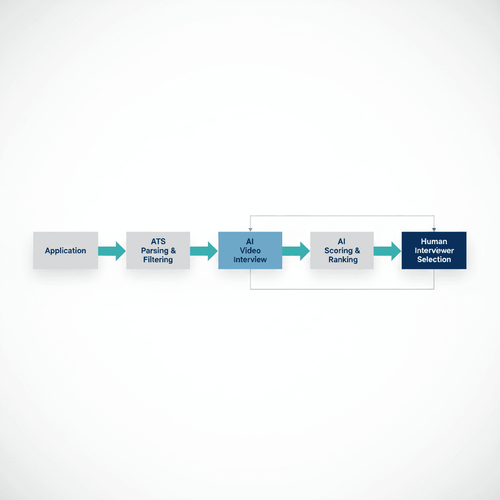
For most fast-growing startups, the choice isn’t ATS or AI-it’s how to combine them. ATS handles the logistics and volume; AI adds depth to candidate assessment. Integration between the two creates a seamless flow from application to evaluation.
A hybrid system might work like this: the ATS parses resumes and filters candidates based on non-negotiable skills.
Qualified applicants then undergo an AI-conducted video interview, which assesses behavioral and situational responses.
The AI scores and ranks them, and the shortlist goes to human interviewers for final selection.
This preserves human judgment where it matters most while automating the repetitive stages. This approach also future-proofs your hiring.
As AI models improve-drawing on advances in generative AI and active learning-they can take on more nuanced screening tasks.
Startups that build a flexible, integrated system today will find it easier to adopt new capabilities tomorrow.
Implementation Considerations for Startups
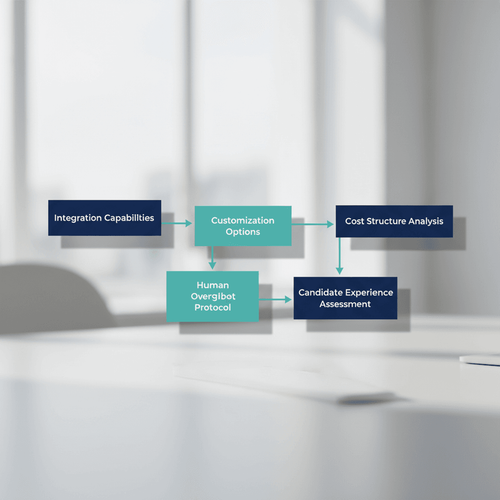
Adopting any new tool requires planning. When evaluating ATS or AI screening systems, startups should consider:
- Integration capabilities: Can the tool sync with your existing HR software or communication platforms?
- Customization: Does it allow you to set your own criteria and adjust workflows as roles evolve?
- Cost structure: Pricing models vary-some charge per seat, others per candidate or job posting. Align this with your hiring volume.
- Human oversight: Ensure there’s always a way for recruiters or hiring managers to review, override, or interpret AI recommendations.
- Candidate experience: AI interviews can feel impersonal if not designed well. Look for systems that offer clear instructions and respectful communication.
Pilot new tools with a single team or role before rolling them out widely. Gather feedback from both candidates and hiring managers to refine the process.
Conclusion
- ATS excels at managing high-volume applications and bringing order to the hiring pipeline, making it ideal for startups scaling quickly.
- AI interview screening adds evaluative depth, offering objective, consistent assessments of candidate fit while potentially reducing bias.
- Efficiency gains differ: ATS optimizes logistics; AI accelerates quality decision-making.
- Bias mitigation requires active effort in both systems, but AI screening offers more nuanced controls when designed transparently.
- A hybrid approach often delivers the best of both worlds, combining ATS efficiency with AI intelligence for an end-to-end hiring solution.
Future Directions
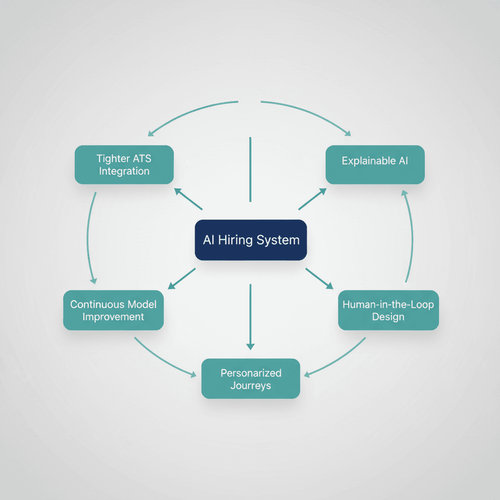
- Tighter integration between ATS and AI screening will enable more seamless data flows and richer candidate insights.
- Explainable AI advancements, as seen in ultra-strong machine learning research, will help hiring teams understand and trust AI recommendations.
- Continuous model improvement through feedback loops will make AI screening more accurate and fair over time.
- Human-in-the-loop designs will evolve to better combine AI speed with human empathy and judgment.
- Personalized candidate journeys could emerge, using AI to tailor interactions based on role or candidate potential.
References
- “Foundations of GenIR” (2025) – on generative AI model development and application in screening contexts.
- “Fragment Descriptors in Virtual Screening” (2013) – discusses pattern recognition methods relevant to AI-driven candidate assessment.
- “Ultra Strong Machine Learning: Teaching Humans Active Learning Strategies via Automated AI Explanations” (2025) – explores model transparency and human-AI collaboration.