
Hiring Metrics That Matter: How to Track Time-to-Hire and Reduce Costs in 2025
Discover the hiring metrics that matter in 2025, including time-to-hire, to reduce recruitment costs, improve efficiency, and secure top talent faster.
Table of Contents

Introduction
If you spend any time on professional networks like LinkedIn, you'll see a recurring theme: hiring is broken.
There's a palpable frustration with drawn-out processes, ghosted candidates, and budgets that evaporate without yielding the right talent.
This isn't just noise. For startups and hiring managers in 2025, this sentiment underscores a critical business reality:
inefficient hiring isn't just an HR problem; it's a direct threat to operational continuity and financial health.
In our context of constrained resources and ambitious growth targets, every day a role remains open has a tangible cost.
This is where moving beyond gut feeling to data-driven hiring becomes non-negotiable. The right metrics act as a compass, guiding you away from costly inefficiencies and towards a streamlined, effective recruitment strategy.
This article will provide a practical framework for understanding the hiring metrics that truly matter, with a deep dive into the pivotal role of time-to-hire.
We will explore how to track it accurately, demonstrate its direct link to cost reduction, and outline a holistic set of supporting metrics and technologies that, together, form a robust system for hiring success in 2025.
Why Time-to-Hire is Your North Star Metric
Time-to-hire (TTH) is defined as the number of calendar days between when a candidate enters your pipeline (e.g., applies for a role) and when they accept your offer.
It's a key performance indicator (KPI) that reflects the efficiency and agility of your entire hiring engine.
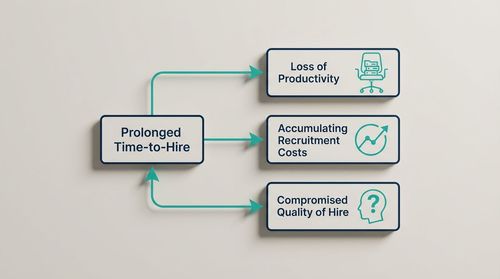
A prolonged TTH has a cascading negative impact that directly inflates costs. First, there is the immediate loss of productivity.
An open seat means existing team members often shoulder additional work, leading to potential burnout, decreased morale, and a decline in the quality of their output. Second, recruitment costs accumulate.
The longer a search drags on, the more you spend on job board renewals, recruiter man-hours, and potentially escalating agency fees. Third, and most critically, a slow process often leads to a compromised quality of hire.
Top-tier candidates, who are typically in the market for a short time, will not wait. They drop out, accepting offers from faster-moving competitors.
This can force teams to make rushed decisions on less-suitable candidates, which in turn increases the risk of early turnover, triggering the entire costly cycle again.
A Practical Framework for Tracking Time-to-Hire

To manage TTH, you must first measure it correctly. This requires moving from a vague notion of "how long it takes to hire" to a precise, stage-by-stage analysis.
1. Defining Your Hiring Process Funnel

Map your entire candidate journey. A typical funnel includes stages like:
- Sourcing: Candidate applies or is sourced.
- Screening: Resume review, initial phone screen.
- Interviewing: Technical assessments, hiring manager interviews, team interviews.
- Decision: Debrief, offer extended.
- Acceptance & Onboarding: Offer accepted, pre-employment checks, start date.
2. Setting Stage-Specific Metrics

With the funnel defined, you can track granular metrics that illuminate bottlenecks:
- Time-to-Screen: How long from application to first contact?
- Time-to-First-Interview: The delay between application and the first substantive interview.
- Time-to-Offer: The internal speed of your decision-making post-final interview.
- Offer Acceptance Rate: The percentage of offers accepted. A low rate indicates issues with the offer itself or the candidate's experience.
Implementing an Applicant Tracking System (ATS) is no longer optional for effective tracking.
A modern ATS automatically captures timestamps at each stage, providing the data needed to calculate these metrics accurately and identify exactly where candidates are getting stuck.
The Direct Link: Reducing Time-to-Hire to Cut Costs
Optimising TTH is one of the most powerful levers for cost control. The strategies to achieve this are multifaceted and interdependent.
Leveraging Predictive Technology

This is where data analytics and machine learning move from buzzwords to practical tools. AI-powered systems can now optimise hiring decisions in several ways:
- Intelligent Screening: Algorithms can rapidly screen large applicant pools against job requirements, prioritising the most promising candidates for human review and drastically cutting down time-to-screen.
- Bias Reduction: By focusing on skills and experience data rather than demographic cues, these tools can help create a more diverse and qualified shortlist.
- Predictive Analytics: Some systems analyse data from successful employees to identify patterns in candidate profiles that correlate with long-term performance, improving the quality of hire.
Enhancing Candidate Experience and Employer Brand

Candidate satisfaction is not a soft metric; it's a hard economic driver.
A positive, respectful candidate experience-characterised by transparency, feedback, and efficient scheduling-directly improves your offer acceptance rate.
Candidates who feel valued are more likely to accept your offer, reducing the need to restart searches.
This positive experience, shared publicly, strengthens your employer brand, making it easier and faster to attract top talent in the future, creating a virtuous cycle that naturally lowers your TTH and cost-per-hire.
Beyond Time-to-Hire: The Essential Supporting Metrics

While TTH is critical, it doesn't tell the whole story. A fast hire who leaves within six months is more expensive than a slightly slower hire who becomes a star performer. A balanced hiring dashboard must include these complementary metrics:
-
Cost-Per-Hire (CPH): This calculates the total cost of hiring a new employee. The formula is typically (Internal Recruitment Costs + External Recruitment Costs) / Total Number of Hires. Tracking CPH helps you quantify the ROI of your recruitment strategies and identify areas for cost reduction, such as reallocating spending from low-yield job boards to more effective channels like employee referrals.
-
Quality of Hire: This is a composite metric, often measured through post-hire performance reviews, retention rates after one year, and hiring manager satisfaction. It answers the fundamental question: "Are we hiring the right people?" Optimising for speed without regard for quality is a costly mistake.
-
Source of Hire (SOH): Understanding which channels (e.g., LinkedIn, employee referrals, specific job boards) produce your most successful and longest-tenured employees allows you to optimise your recruitment marketing budget. Doubling down on high-quality sources improves both TTH and quality of hire.
-
Time-to-Productivity: This measures how long it takes for a new employee to become fully productive in their role.
A short TTH is futile if the onboarding process is poor. Investing in structured training and mentorship programmes reduces time-to-productivity, delivering value from your new hire faster and improving job satisfaction and retention.
Conclusion: Building a Cohesive, Cost-Effective Hiring System

The hiring landscape of 2025 demands a systematic, metrics-driven approach. The goal is not to be the fastest at all costs, but to build an efficient, respectful, and effective system that balances speed with quality.
- Time-to-Hire is a primary lever for cost control. A prolonged hiring process directly increases recruitment expenses, lost productivity, and the risk of bad hires.
- Effective tracking requires process mapping and technology. An ATS is essential for capturing the granular data needed to identify and eliminate bottlenecks.
- Technology like AI and analytics can optimise decision-making. From intelligent screening to predictive success modelling, these tools are key to reducing time-to-hire and improving quality.
- Candidate experience and quality metrics are non-negotiable. A fast process that alienates candidates or results in poor hires is ultimately more expensive. Metrics like candidate satisfaction, quality of hire, and time-to-productivity provide the necessary balance.
By focusing on this interconnected set of metrics and implementing the supporting strategies, organisations can transform their hiring function from a cost centre into a strategic advantage. This disciplined approach enables startups and hiring managers to allocate resources efficiently, build high-performing teams, and achieve sustainable growth.