
How Founders Are Cutting Hiring Time from 3 Weeks to 3 Days (Without a Full HR Team)
How startup founders cut hiring time from 3 weeks to 3 days without a full HR team. Smart AI tools, lean processes, and faster talent decisions explained.
Table of Contents

Introduction
Across the startup ecosystem, a quiet revolution is underway. Founders, often operating without the luxury of a dedicated HR team, are hacking a notoriously slow process.
The traditional three-week hiring cycle-a crawl through resume mountains, scheduling nightmares, and deliberation deadlock-is being compressed into a mere three days.
This isn't just about moving faster; it’s a fundamental re-architecture of talent acquisition, driven by necessity and powered by smart technology.
For a founder, every day a key role remains unfilled is a direct drag on growth, innovation, and morale. The academic literature, such as the challenges outlined in "False-name-proof Mechanisms for Hiring a Team," underscores the immense difficulty of building effective teams, especially at scale.
Without a large HR apparatus to shoulder the burden, founders are turning to a powerful combination: AI-powered automation to handle administrative friction and a paradigm shift in human assessment called the "interview-first" model.
This article will delve into the mechanics of this hybrid approach, explore the technical architecture that makes it possible, and provide a practical roadmap for founders and hiring managers looking to build high-performing teams with unprecedented speed and precision.
The Anatomy of a Broken System: Why Three Weeks Was the Norm
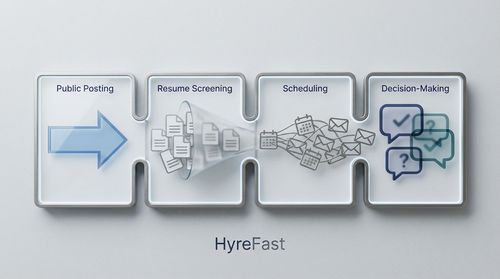
To appreciate the new three-day model, we must first understand why the old system was so slow.
The traditional hiring pipeline is a sequential process plagued by bottlenecks. It typically begins with a public posting that generates a high volume of applications, many of which are unqualified.
The first major bottleneck is resume screening.
As noted in "Learning to Hire Teams," sifting through an "available pool of applicants" to find the right fit is a significant challenge, consuming dozens of hours from already-stretched-thin founders and team leads.
The second bottleneck is scheduling. Coordinating the calendars of multiple interviewers with the availability of candidates can stretch into days, if not a full week, of back-and-forth emails.
The final bottleneck is the decision-making process itself. Without a structured way to evaluate candidates, debrief meetings can become anecdotal and subjective, leading to indecision or, worse, mis-hires that cost the company dearly down the line. \
This sequential, manual process is inherently inefficient. The three-week timeline wasn't a target; it was a symptom of a system built for a different era.
The New Playbook: A Hybrid of Automation and Human Insight

The strategy for compressing this timeline rests on two pillars: leveraging technology to eliminate administrative delays and redesigning the assessment phase to be more efficient and effective.
Pillar 1: AI-Powered Recruitment Systems
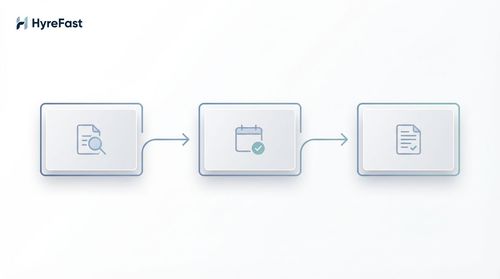
AI-powered platforms are the engine of this transformation. They attack the most time-consuming parts of the process head-on.
- Automated Resume Screening: Modern systems use Natural Language Processing (NLP) to parse resumes and match them against a detailed job description. They don't just look for keywords; they analyse for skill proximity, experience relevance, and project context.
Companies utilising these tools report a 92% reduction in resume screening time. This is not about replacing human judgement but about amplifying it-surfacing the top 10% of candidates from a pool of hundreds in minutes, not days.
- Intelligent Scheduling: AI schedulers integrate directly with calendar APIs (like Google Calendar or Outlook) to find mutual availability between candidates and interviewers. This eliminates the scheduling bottleneck entirely, reducing what was a multi-day email chain to a process that takes under an hour. The candidate simply selects a time slot, and the interview is booked.
- Preliminary Assessments: These platforms often include integrated testing modules for coding challenges, situational judgement tests, or personality inventories. This provides a data point on candidate competency before the first human interaction, ensuring that interview time is reserved for the most promising applicants.
Pillar 2: The Interview-First Screening Model
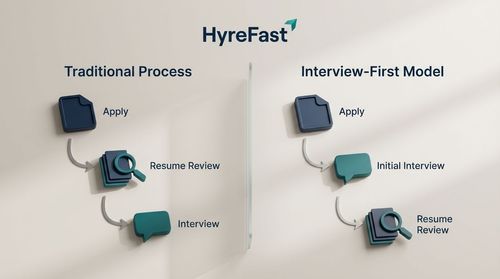
This is the more profound innovation.
Instead of the traditional sequence of Apply → Screen Resume → First-Round Interview,
the interview-first model inverts the process: Apply → Initial Structured Interview → Resume Review.
Why this inversion? The research into team building highlights that success often hinges on soft factors like communication, problem-solving approach, and cultural fit-elements a resume can barely hint at.
By conducting a short, structured video interview first, founders assess these critical dimensions directly.
This 30-minute conversation, focused on a few core competencies, is far more predictive of success than a piece of paper.
It filters for the human qualities that matter most. Only after a candidate passes this interactive screen does the team invest time in a deep dive into their resume and portfolio.
This approach has been shown to improve the quality of hire, enhance diversity by mitigating unconscious bias in resume review, and drastically speed up the initial filtering stage.
The Three-Day Hiring Sprint: A Practical Workflow
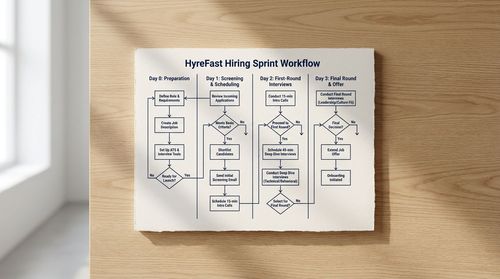
So, how do these pillars come together in a real three-day sprint? Here is a sample workflow:
- Day 0 (Preparation): The foundation is laid. The hiring team defines crystal-clear job requirements and crafts a structured interview guide with 4-5 core questions that probe key competencies. They also establish a simple scoring rubric (e.g., 1-5 scale) for each question to ensure consistency.
- Day 1 (Screening & Scheduling):
- Morning: The job posting goes live. An AI screener is activated to filter incoming applications.
- Afternoon: The founder or hiring manager reviews the AI-curated shortlist (e.g., top 10 candidates). Using the AI scheduler, they block out 30-minute slots for the following day and invite the shortlisted candidates. The entire scheduling process is completed in under an hour.
- Day 2 (First-Round Interviews):
- The "interview-first" model is executed. The founder conducts the structured video interviews back-to-back. Each interview is scored immediately after completion using the predefined rubric.
- By the end of the day, based on the scores, the top 2-3 candidates are identified for the final round.
- Day 3 (Final Round & Offer):
- Morning: The final round is conducted, which could be a more in-depth technical discussion or a culture-fit conversation with another team member.
- Afternoon: The hiring team meets for a concise 30-minute debrief. With structured scores in hand, the decision is data-driven and swift. An offer is extended to the top candidate by the end of the day. This workflow is intense but effective. It replaces vague deliberation with a disciplined, fast-moving process.
Challenges, Mitigations, and Ethical Considerations
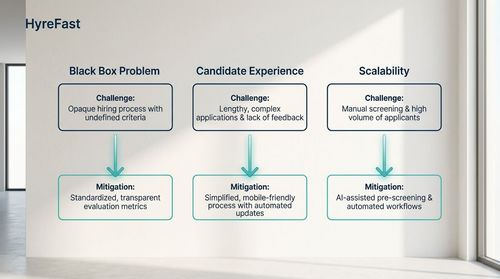
No system is perfect, and this accelerated approach has its friction points.
- The Black Box Problem: Over-reliance on an AI screener can inadvertently perpetuate bias if the underlying algorithms are not carefully audited. Mitigation: The AI should be used as a filtering aid, not a final gatekeeper. The subsequent interview-first round acts as a crucial human check. Founders must choose platforms that are transparent about their bias mitigation strategies.
- Candidate Experience: A highly automated process can feel impersonal. Mitigation: Communication is key. Use automated but warm messaging to keep candidates informed at every stage. The interview-first model, ironically, often provides a better candidate experience as it leads to faster, more direct human interaction.
- Scalability for Large Teams: The model is optimised for founder-led hiring. As companies grow and hiring volume increases, the "A quantitative perspective on ethics in large team science" raises important questions about how research culture changes with scale. Similarly, a hiring process must evolve. The core principles remain, but the execution may require a more coordinated, multi-interviewer approach to avoid founder burnout.
The ethical dimension is critical. As we automate and accelerate, we must ensure fairness and transparency. The goal is not just to hire fast, but to hire right—building teams that are both capable and diverse.
Conclusion and Future Directions

The compression of the hiring timeline from weeks to days is not a fantasy; it is an operational reality for a growing number of resourceful founders. By strategically combining AI-driven efficiency with a human-centric interview-first approach, they are overcoming the classic startup constraint of limited HR bandwidth.
- The hybrid model is key. AI handles the administrative grind, while a structured, initial interview focuses human attention on the factors that matter most for team success.
- Clarity and structure drive speed. Clearly defined job requirements and a standardized interview rubric eliminate ambiguity and accelerate decision-making.
- This is a scalable philosophy. While the three-day sprint is a specific tactic, the principles of automation, structured assessment, and efficient workflow design are applicable to organisations of any size.
Looking ahead, the evolution of this space is exciting. We can anticipate more sophisticated AI that can analyse video interviews for communication cues, providing even richer data to hiring teams. The integration of project-based assessments that mirror real-world work will become more seamless.
The lessons from building large teams in scientific endeavours will increasingly inform best practices in the corporate world. For founders and hiring managers, the message is clear: the tools and strategies to build your team faster and smarter are already here. It’s time to put them to work.
References
- False-name-proof Mechanisms for Hiring a Team (ArXiv) - [Link Context: Discusses challenges in team formation.]
- Learning to Hire Teams (Core Lit) - [Link Context: Explores the challenge of building effective teams from a candidate pool.]
- A quantitative perspective on ethics in large team science (Core Lit) - [Link Context: Provides insights on the impact of scale on collaborative endeavours.]
- AI-Powered Recruitment Systems (Web Agent) - [Link Context: Describes the benefits of automation in hiring.]
- Interview-First Screening Model (Social Media/Web Agent) - [Link Context: Highlights the trend of prioritising human interaction early in the process.]