
How Recruitment Agencies Are Using AI to Deliver Shortlists 5x Faster to Clients
How AI helps recruitment agencies deliver faster, smarter candidate shortlists at scale
Table of Contents

Introduction
The recruitment industry is in the midst of a quiet revolution. For decades, the model remained largely unchanged:
clients submitted job requirements, recruiters sifted through resumes manually, conducted phone screens, and submitted a shortlist-often taking weeks to deliver results. In today's hyper-competitive talent market, that timeline is no longer acceptable.
Companies need to hire faster, and they're holding their recruitment partners accountable for speed without sacrificing quality.
The answer lies in artificial intelligence. Forward-thinking recruitment agencies across India and globally are deploying AI-powered tools at every stage of the hiring funnel-from initial sourcing to final shortlist delivery-to achieve speeds that were previously unimaginable.
The results are striking: agencies report delivering qualified shortlists five times faster than traditional methods, while simultaneously improving candidate quality and reducing costs.
This article explores how recruitment agencies are leveraging AI to transform their operations, the specific technologies driving this change, and what this means for the future of the staffing industry.
The Traditional Bottleneck: Why Recruitment Was Slow
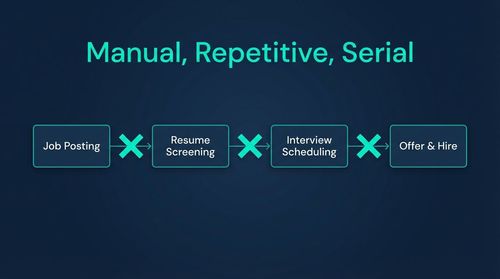
Before understanding the solution, we must understand the problem. Why did traditional recruitment take so long? The answer lies in the inherently manual, repetitive, and serial nature of the process.
The Resume Screening Bottleneck
The most time-consuming stage of recruitment is also the most critical: screening. For a single mid-level role, a recruiter might receive 200 to 500 applications. Manually reviewing each resume, cross-referencing against job requirements, and making go/no-go decisions consumes 15 to 30 minutes per candidate.
For 300 applicants, that's 75 to 150 hours of pure screening time-nearly two to four full work weeks [1].
This manual process is not just slow; it's inconsistent. Different recruiters apply different standards. Fatigue sets in after the first 50 resumes, leading to missed qualified candidates and advancement of underqualified ones.
The result is a slow, error-prone process that frustrates clients and candidates alike.
The Communication Overhead
Every candidate in the pipeline requires communication: initial acknowledgment, scheduling updates, interview feedback, and rejection notices.
For a role with 300 applicants, that's hundreds of emails, phone calls, and messages. Recruiters spend 30-40% of their time on administrative communication rather than high-value activities like candidate engagement and client consultation [2].
The Scheduling Chaos
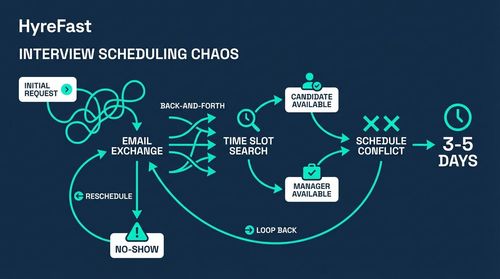
Coordinating interviews between hiring managers and candidates is a logistical nightmare. Back-and-forth emails to find mutually available time slots, rescheduling for no-shows, and follow-ups consume disproportionate recruiter time.
A single interview scheduling cycle can take 3 to 5 days to complete.
The AI Revolution: Technologies Transforming Recruitment
Modern recruitment agencies are deploying a sophisticated stack of AI technologies to address these bottlenecks.
These tools don't replace human recruiters-they augment their capabilities, handling repetitive tasks while freeing consultants to focus on relationship-building and strategic judgment.
1. Intelligent Resume Parsing and Matching
The first layer of AI intervention is at the entry point: the resume. AI-powered parsing engines can now extract key information from unstructured resumes-candidate name, contact details, work history, skills, education, and certifications-with over 95% accuracy [3].
More importantly, semantic matching algorithms go beyond keyword matching.
They understand the context and meaning behind skills and experiences.
For example, a candidate with "Python" experience and a project titled "data analysis" will be correctly matched to a role requiring "Python" and "data analytics"-even if the exact keywords don't appear. This technology can reduce initial screening time by 70-80% [4].
2. Candidate Rediscovery and Pipeline Warming
Many recruitment agencies sitting on massive databases of past candidates-sometimes hundreds of thousands of profiles-rarely revisit these archives.
AI-powered candidate rediscovery tools can scan these databases to identify past applicants who match new requirements. A role that would traditionally require fresh sourcing can often be filled from existing pipeline data within hours.
This approach is particularly powerful for roles with recurring skill requirements. Agencies report that 20-30% of placements now come from rediscovery, significantly reducing time-to-shortlist [5].
3. Automated Candidate Communication
AI-powered chatbots and email automation are transforming candidate communication. Chatbots can handle initial candidate inquiries, answer frequently asked questions about the role and process, and even conduct preliminary qualification checks through conversational interfaces.
Conversational AI can engage with candidates 24/7, schedule interviews automatically based on calendar integrations, and send personalized updates at scale. This reduces recruiter administrative time by 40-50% while improving candidate experience through instant responses [6].
4. Predictive Analytics for Candidate Success
Advanced agencies are using predictive analytics to go beyond matching skills to predicting job fit. By analyzing historical data on successful placements,
AI models can identify patterns that correlate with long-term success: specific skill combinations, career progression trajectories, and even cultural alignment indicators.
This allows recruiters to shortlist not just candidates who look good on paper, but those statistically more likely to succeed and stay in the role-improving quality-of-hire while reducing turnover.
5. Intelligent Interview Scheduling
AI-powered scheduling tools integrate with recruiter and hiring manager calendars to automatically identify available slots, send invitations to candidates, and handle rescheduling.
These tools can reduce scheduling time from days to minutes and virtually eliminate the back-and-forth that frustrates both candidates and clients [7].
The 5x Speed Achievement: How It's Being Done
The claim of delivering shortlists five times faster is not hyperbole-it's the result of compressing timelines at every stage of the recruitment funnel. Here's how agencies are achieving this:
Before AI: The Traditional Timeline
| Stage | Traditional Time |
|---|---|
| Job Requirement Understanding | 1-2 days |
| Sourcing (manual job posting, database search) | 3- 5 days |
| Resume Screening | 5-10 days |
| Candidate Communication | 2-3 days |
| Interview Scheduling | 3-5 days |
| Total Time to Shortlist | 14-25 days |
With AI: The Accelerated Timeline
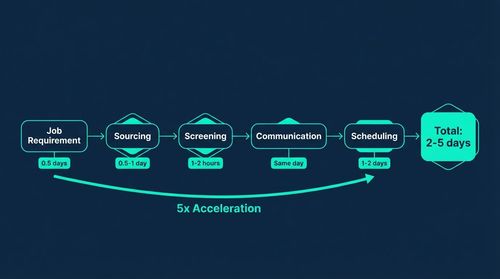
| Stage | AI-Accelerated Time |
|---|---|
| Job Requirement Understanding | 0.5 days (AI-assisted parsing) |
| Sourcing (automated + rediscovery) | 0.5-1 day |
| Resume Screening (intelligent matching) | 1-2 hours |
| Candidate Communication (chatbots) | Same day |
| Interview Scheduling (automated) | 1-2 days |
| ** Total Time to Shortlist** | 2-5 days |
| The compression comes from parallel processing. While AI handles screening, sourcing, and initial communication in hours, human recruiters focus on high-touch activities like candidate engagement and client relationships. The net result is a 5x acceleration in time-to-shortlist. |
Real-World Impact: Agencies Leading the Change
- A Mumbai-Based Executive Search Firm: Specializing in senior leadership placements, they implemented AI-powered sourcing and matching for a C-suite mandate. Result:
- Delivered a shortlist of 8 qualified candidates in 4 days-compared to the traditional 3-4 weeks-while maintaining a 100% interview-to-shortlist conversion rate.
- A Bengaluru Staffing Agency: Processing 500+ entry-level tech hires monthly, they deployed AI for resume screening and candidate communication. Result: Reduced time-to-shortlist from 12 days to 2 days, and increased recruiter capacity by 300% without adding headcount.
- A Pan-India IT Staffing Company: Using predictive analytics for candidate shortlisting, they improved candidate retention at the 6-month mark by 35%, demonstrating that speed does not have to come at the cost of quality.
Challenges and Considerations: Navigating the AI Transition
While the benefits are clear, recruitment agencies must navigate several challenges when implementing AI:
1. Data Quality and Integration
AI models are only as good as the data they're trained on. Agencies must invest in cleaning and structuring their candidate databases, integrating disparate tools, and ensuring data privacy compliance (especially under India's Digital Personal Data Act).
2. The Human Touch Remains Critical
AI can screen, match, and schedule-but it cannot build relationships, understand nuanced client requirements, or assess cultural fit through conversation.
The most successful agencies use AI to augment their recruiters, not replace them. The recruiter's role evolves from screeners to strategic advisors.
3. Bias and Fairness
AI systems can inadvertently perpetuate biases present in historical data. Agencies must audit their AI tools regularly for fairness, ensure diverse training data, and maintain human oversight in final decision-making.
4. Client Education
Some clients remain skeptical of AI-driven shortlists. Agencies must educate clients on how AI works, demonstrate its accuracy, and show that speed improvements do not compromise quality.
The Future: What's Next for AI in Recruitment
The trajectory is clear: AI will become increasingly embedded in recruitment operations. Emerging trends include:
- Generative AI for Job Descriptions: AI can draft compelling, bias-free job descriptions in minutes based on role requirements.
- Skills-Based Matching: Moving beyond experience-based hiring to skills-based matching, identifying candidates with transferable skills who might otherwise be overlooked.
- Real-Time Market Intelligence: AI-powered dashboards providing clients with salary benchmarks, talent availability, and competitive insights.
- Automated Interview Transcription and Analysis: AI that transcribes interviews, extracts key insights, and provides scoring assistance to hiring managers.
Conclusion: Speed as a Competitive Advantage
In the battle for talent, speed is a decisive competitive advantage. Companies that hire faster secure the best candidates; agencies that deliver faster win more client business.
AI is not a luxury-it's becoming a necessity for recruitment agencies that want to remain relevant.
The agencies winning today are those that have reimagined their operations around AI, using technology to handle the mechanical while investing heavily in the human capabilities that machines cannot replicate:
relationship building, strategic counsel, and nuanced judgment. The future of recruitment is not man versus machine-it's man with machine.
And that combination is delivering shortlists five times faster than ever before.
References
- SHRM. "Cost-Per-Hire and Time-to-Fill Benchmarks." 2024.
- LinkedIn Talent Solutions. " Recruiter Time Allocation Study." 2023.
- TextKernel. "Resume Parsing Accuracy Benchmarks." 2024.
- Moka HR. "AI Screening Efficiency Report." 2024.
- Allegis. "Candidate Rediscovery Impact Study." 2023.
- Paradox. "Conversational AI in Recruiting." 2024.
- Calendly. "Automated Scheduling Efficiency Data." 2024.