
How to Deliver Shortlists in 48 Hours - Without Compromising Candidate Quality
Table of Contents

Introduction
In the high-stakes world of talent acquisition, speed has become a non-negotiable competitive advantage. Clients no longer tolerate lengthy hiring cycles—they need qualified candidates fast, whether to fill a critical tech role before a project launch, scale a customer support team for a seasonal spike, or replace a key employee who’s given notice. Yet, the pressure to move quickly often leads to a dangerous trade-off: rush the process, and you risk presenting poorly vetted, mismatched, or even unsuitable candidates—damaging client trust, wasting everyone’s time, and harming your agency’s reputation. The good news is that delivering high-quality shortlists in 48 hours isn’t a myth—it’s an achievable reality for recruitment agencies that have re-engineered their screening process around intelligence, automation, and strategic focus. The top agencies in India and globally aren’t sacrificing quality for speed; they’re achieving both by eliminating waste, leveraging AI and automation to handle the eliminable, and redirecting recruiter energy toward high-signal, high-value activities. This isn’t about cutting corners or relying on gut feeling. It’s about building a screening engine that’s fast because it’s smart—one that uses technology to filter out noise, surface genuine talent, and provide recruiters with the clarity and time they need to make informed, defensible judgments. In this article, we’ll break down exactly how to deliver shortlists in 48 hours without compromising candidate quality. We’ll dissect the hidden time sinks in traditional screening, explore the technological and process-driven levers of speed, and provide a practical, step-bycket blueprint you can implement to transform your agency’s screening from a bottleneck into a competitive advantage.
Why Traditional Screening Fails the Speed-Quality Test
Before building the solution, it’s essential to understand why most agencies struggle to deliver quality shortlists quickly. The problem isn’t usually a lack of effort—it’s a misallocation of effort. Traditional screening processes are plagued by hidden inefficiencies that waste recruiter time on low-value tasks while failing to adequately assess what truly matters.
1. The Resume Triage Black Hole: Wasting Hours on Low-Signal Noise
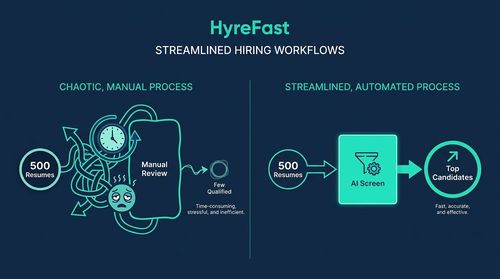
This is the single largest time sink in most screening processes—and it’s where quality often suffers most.
- The Problem: Recruiters spend hours manually reviewing resumes, often applying inconsistent criteria and getting bogged down in irrelevant details. A significant portion of this time is spent on candidates who are immediately disqualifiable by objective criteria: wrong location, missing certification, insufficient experience, or unavailable for required shifts.
- The Quality Risk: Manual triage is prone to fatigue, bias, and inconsistency. After reviewing 50-100 resumes, decision fatigue sets in, increasing the likelihood of missing subtle qualifications or being unduly influenced by irrelevant factors (like resume formatting or a familiar company name). Moreover, without a standardized framework, it’s hard to ensure that all candidates are being evaluated on the same basis.
- The Time Cost: Screening 500 applications manually at just 90 seconds per resume takes 6.25 hours—before a single human interaction has occurred. At a more realistic 2-3 minutes per resume, that’s 16.5-25 hours—over three full workdays.
2. The Scheduling and Communication Vortex: Administrative Overload
Once a recruiter identifies a potentially promising candidate, the logistical nightmare of scheduling begins—and it scales poorly.
- The Problem: Coordinating even a single interview between a recruiter, hiring manager, and candidate can require 5-7 email or message exchanges. For a shortlist of 5 candidates needing two rounds each, this can easily consume 3-5+ hours of recruiter time—time spent not on evaluating talent, but on logistics.
- The Quality Risk: This is pure administrative overhead. It doesn’t require a recruiter’s expertise, empathy, or judgment—it’s a task that feels beneath their skill level and contributes to frustration and burnout. Worse, delays in scheduling can cause candidates to lose interest or accept other offers, indirectly reducing the quality of the final shortlist by eliminating strong contenders who move on.
3. The Initial Screen: Talking Without Qualifying
Even after a resume passes muster and an interview is scheduled, the initial screening call often fails to efficiently determine fit.
- The Problem: These calls frequently devolve into unstructured conversations where the recruiter rehashes resume details, fails to ask targeted knockout questions (e.g., “Are you available to work weekends?”, “What is your expected salary?”, “Do you have reliable transportation?”), or spends too much time building rapport before assessing basic compatibility.
- The Quality Risk: Without a structured guide, recruiters may talk for 15-20 minutes only to discover a fundamental mismatch that could have been resolved in 2-3 minutes. This wastes time for both recruiter and candidate and increases the likelihood of progressing with candidates who have avoidable disqualifiers.
- The Time Cost: Inefficient initial screens can easily consume 2-4 hours per requisition in wasted talk time—time that could have been spent assessing genuine fit or engaging more promising candidates.
4. The Reactive Sourcing Trap: Starting from Scratch Every Time
Many agencies treat each requisition as a brand-new project, ignoring the wealth of data and relationships they’ve already built.
- The Problem: Instead of leveraging past applicants, silver medalists (strong candidates who just missed out), or engaged talent pools, recruiters start each search with a blank slate, re-sourcing the same channels and re-screening the same types of profiles.
- The Quality Risk: This ignores the fact that a significant portion of the talent needed for recurring high-volume roles (e.g., monthly BPO hiring, quarterly retail spikes) consists of familiar faces—people who have applied before, know the process, and are often quicker to re-engage. It also means missing out on the opportunity to build velocity through familiarity and trust.
- The Time Cost: This represents redundant effort in sourcing and screening, directly increasing the time required to build a qualified shortlist.
5. The Feedback Vacuum: Lack of Iteration and Refinement
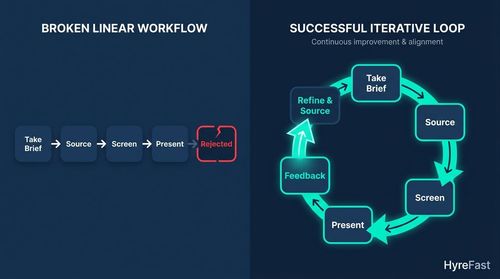
Traditional agency workflows are often linear: take brief → source → screen → present → (if rejected) start over. This model assumes the initial brief was perfect and that learning happens only between discrete searches, not within them.
- The Problem: Without iterative feedback loops, agencies miss the opportunity to refine their understanding of the role in real time. The first shortlist should be a hypothesis, not a final answer. Each round of feedback should clarify what the client really values vs. what they said they valued, which aspects are flexible, and which are truly non-negotiable.
- The Quality Risk: By presenting a “final” shortlist too early and not treating feedback as data for course correction, agencies miss the chance to align with the client’s evolving needs—leading to repeated rejections and wasted effort.
The 48-Hour Shortlist Engine: A System Built for Speed and Quality
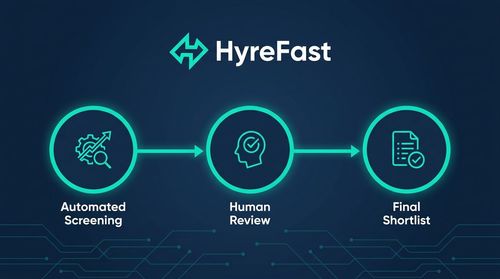
The agencies that consistently deliver high-quality shortlists in 48 hours aren’t working harder—they’re working smarter. They’ve redesigned their screening process into a streamlined, intelligent flow where automation handles the eliminable, and human judgment is reserved for what it does best. Here’s how they do it, broken down into actionable phases.
Phase 1: Eliminate the Noise—Automated Eligibility Gates (Target: 50-70% Reduction in Initial Review Time)
The Core Idea: Stop wasting recruiter time on candidates who are objectively unqualified. Use technology to apply objective filters at the very top of the funnel, before any human eyes see a resume.
How It Works: The Knockout Questionnaire Funnel
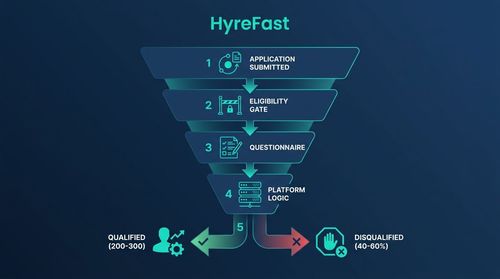
Instead of letting all applications flow into a manual review queue, smart agencies insert an automated eligibility gate immediately after application submission. This gate consists of a short, role-specific questionnaire delivered via SMS, email, or within the application flow itself.
- Typical Questions (Role-Dependent):
- "Are you legally authorized to work in [Country/City] without sponsorship?" (For roles requiring local hiring)
- "Do you have [X] years of experience with [Specific Skill/Technology]?" (e.g., "Do you have 2 years of experience with AWS?")
- "Are you available to work [Required Shifts]?" (e.g., "Can you work night shifts?")
- "Do you hold a valid [Certification/License]?" (e.g., "Do you have a current forklift operator certificate?")
- "What is your expected monthly salary/CTC?" (To filter out candidates far outside budget)
- "What is your earliest available start date?"
- The Technology: This isn’t just a basic web form. Smart agencies use:
- Integrated Assessment Platforms: Tools like HireVue, Harver, or Codility (for basic checks) that can host questionnaires and automatically pass/fail candidates based on responses.
- Smart Form Tools with Logic: Platforms like Typeform, Google Forms (with Apps Script), or JotForm that use conditional logic to show/hide questions and calculate eligibility.
- ATS-Integrated Screening: Many modern ATS systems (e.g., Greenhouse, Lever, Workday) have built-in screening capabilities that can trigger automated emails/SMS with links to questionnaires and update candidate status based on responses.
- The Impact: This single step can instantly eliminate 40-60% of applicants who fail to meet basic, non-negotiable criteria. Instead of 500 resumes entering the human review queue, you might have 200-300—saving 3-5 hours of recruiter time immediately. Crucially, the time saved isn’t just in minutes—it’s in shifting the recruiter’s focus from elimination to evaluation.
Phase 2: Rank the Signal—AI-Powered Semantic Search and Matching (Target: Further 30-50% Reduction in Review Time)

The Core Idea: Don’t make recruiters read every remaining resume sequentially. Use AI to understand the meaning of skills and experience, not just match keywords, and surface the highest-potential candidates first.
How It Works: From Keyword Matching to Semantic Understanding
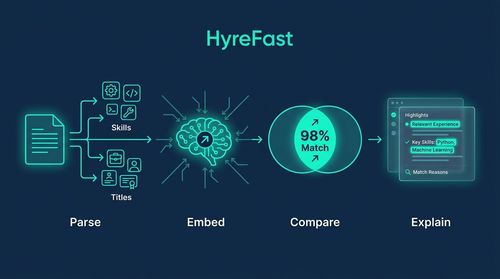
Traditional ATS keyword searches are brittle. They miss candidates who describe their skills differently but are equally qualified (e.g., "built recommendation engines" vs. "machine learning engineer") and can overemphasize irrelevant buzzwords. Smart agencies replace or augment manual boolean searches with AI-powered semantic search and ranking engines. These systems use Natural Language Processing (NLP) and machine learning to:
- Parse Resumes and JDs: Extract entities (skills, titles, companies, dates) and understand context from free-text resumes and job descriptions.
- Create Semantic Embeddings: Convert this information into dense vector representations that capture meaning. For example, the vectors for "Python developer with Pandas experience" and "data analyst using Python for data manipulation" will be close in vector space, even if the exact phrases differ.
- Calculate Conceptual Similarity: Compare the candidate's skill vector against the job's requirement vector using metrics like cosine similarity. Candidates with high conceptual alignment rise to the top of the list, regardless of exact keyword matches.
- Provide Explainable Rankings: Advanced systems don't just give a score—they highlight why a candidate ranked highly (e.g., "Strong match due to experience in AWS EC2 and S3, aligning with job's cloud infrastructure needs").
The Technology Stack:
- Dedicated Talent Intelligence Platforms: Eightfold, Phenom, Beamery, or HireVue's AI matching module use sophisticated NLP and deep learning for semantic matching at scale.
- Fine-Tuned LLMs: Some agencies use open-source or proprietary LLMs (like BERT, Sentence-BERT, or custom models) fine-tuned on recruitment data to understand resume-JD similarity.
- ATS with AI Matching: Leading ATS platforms are increasingly integrating semantic matching capabilities directly into their search functions.
- Open-Source NLP Libraries: For tech-savvy teams, libraries like spaCy, Hugging Face Transformers, or sentence-transformers allow building custom matching pipelines.
The Impact:
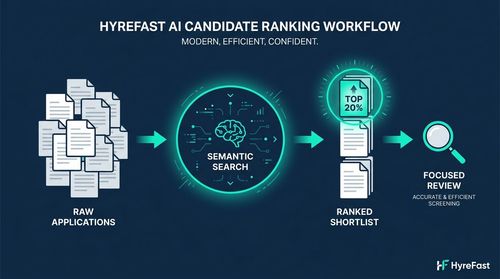
Instead of forcing recruiters to start at the top of a list and work down (potentially missing gems buried deeper), semantic search presents a ranked list where the top 10-20% are the most conceptually aligned candidates. A recruiter can then focus their manual review time on this high-signal subset, confident they're not missing strong fits further down. This can easily reduce the time spent on manual resume review by another 30-50%, as the recruiter is no longer wading through low-signal noise to find the few high-signal nuggets.
Phase 3: Structure the Human Touch—Efficient, Focused Initial Screens (Target: 50% Reduction in Wasted Talk Time)
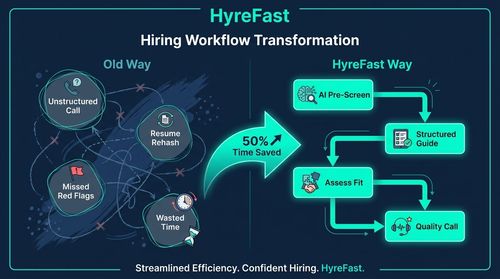
The Core Idea: Ensure that when a recruiter does spend time on a call, it’s focused on assessing genuine fit and motivation—not rehashing resume basics or missing obvious disqualifiers.
How It Works: The Structured, Knockout-Driven Screen
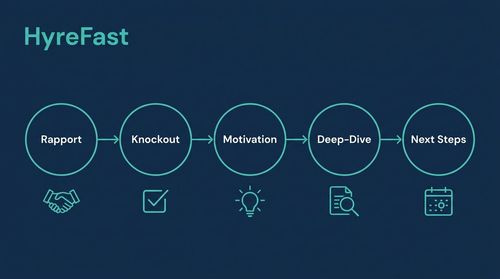
Even after eligibility gates and AI ranking, the initial screening call remains critical for assessing communication, motivation, and nuanced fit. But left unstructured, these calls often waste time. Smart agencies provide recruiters with a standardized, 10-15 minute call guide designed to quickly verify objective fit and gather essential signal. This isn’t a rigid script—it’s a flexible framework that ensures consistency and efficiency.
- The Core Components of an Effective Screening Call Guide:
- Rapid Rapport & Purpose Setting (1-2 min): "Hi [Name], thanks for making time. I'll keep this brief—just 10-15 minutes to confirm a few basics and learn more about your interest in this role."
- Objective Knockout Verification (3-5 min): Re-confirm critical eligibility and logistics:
- "Just to double-check, are you still authorized to work in [Location] without sponsorship?"
- "Are you still available to work [Required Shifts]?"
- "What is your expected salary/CTC for this role?"
- "What is your earliest possible start date?"
- (For technical roles): "Can you walk me through your experience with [Specific Skill] in one or two sentences?"
- Motivation & Interest Check (2-3 min): Assess genuine engagement:
- "What attracted you to this particular role?"
- "What are you looking for in your next step?"
- (For career changers): "What motivated this shift?"
- Resume Deep-Dive on Key Gaps/Highlights (2-3 min): Focus the conversation:
- "Your resume mentions [Project/Experience]—can you tell me more about your role and the outcome?"
- "I noticed a gap between [Date] and [Date]—what were you doing during that time?"
- "Your background is primarily in [X], but this role involves [Y]—how do you see yourself bridging that?"
- Next Steps & Transparency (1 min): Set clear expectations:
- "Thanks for your time. The next step is [technical assessment/manager interview]. I'll aim to get back to you by [date] with feedback."
- The Technology Enablers:
- Call Script Templates: Simple documents or notes within the ATS/CRM.
- AI Note-Taking & Summarization: Tools like Fireflies.ai, Otter.ai, or built-in features in Zoom/Teams that automatically transcribe and highlight key points from calls, freeing the recruiter to listen rather than type.
- Integrated Skill Validation (Optional): For roles requiring basic technical proficiency (e.g., data entry, language fluency), embed a short, validated test before or during the call. Results are available instantly for the recruiter to review (e.g., a 5-minute typing accuracy and speed test for a data entry role).
- The Impact: This approach ensures that recruiter talk time is focused on high-signal areas. It reduces the likelihood of spending 15-20 minutes only to discover a basic mismatch (e.g., salary expectation too high, unwilling to work required shifts) that could have been resolved in 2-3 minutes. Agencies report reducing ineffective talk time by 30-50% while improving the quality of information gathered.
Phase 4: Close the Loop—Automated Communication and Scheduling (Target: Eliminate Administrative Friction)
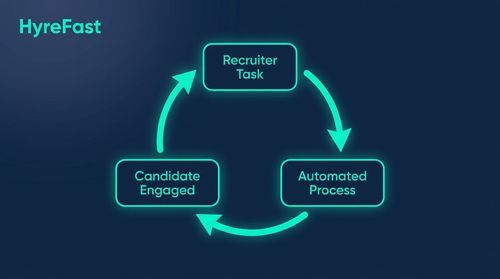
The Core Idea: Turn scheduling and communication from recruiter tasks into seamless, automated background processes that keep candidates engaged and moving.
How It Works: The Self-Service, Trigger-Based Flow
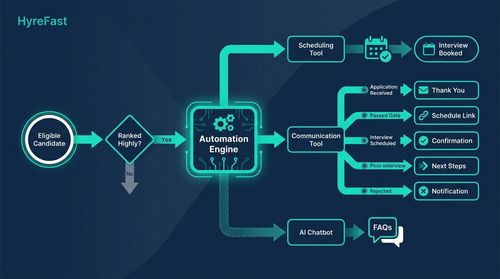
Once a candidate passes the eligibility gate and is ranked highly, smart agencies use automation to handle the next steps without recruiter intervention.
- Automated Scheduling:
- The Tool: AI scheduling assistants (Calendly, X.ai, Clara) or integrated scheduling modules within advanced ATS/CRM platforms.
- The Flow: The system sends the candidate a personalized link to book an interview slot based on pre-defined availability windows set by the recruiter or hiring manager. It handles time zones, sends calendar invites, and manages reminders and rescheduling.
- The Impact: Eliminates the 3-5 email/message exchange typically needed to schedule an interview. Can save 2-4 hours per requisition by turning scheduling into a zero-touch process.
- Automated, Trigger-Based Communication:
- The Tool: Marketing automation (HubSpot, Mailchimp), integrated ATS communication features, or workflow tools (Zapier, Make) that send messages based on candidate status changes.
- The Flow: Pre-written, personalized messages are triggered automatically:
- Application received: "Thanks for applying! We'll review your profile and get back to you within 24 hours."
- Passed eligibility gate: "Great news! You've moved to the next step. Please schedule your interview here [link]."
- Interview scheduled: "Your interview is confirmed for [date/time]. Here's what to expect..."
- Post-interview: "Thanks for your time! We'll update you on next steps by [date]."
- Rejected (after screen): "We've decided to move forward with other candidates whose experience more closely matches this role. We'll keep your profile for future opportunities."
- The Impact: Reduces candidate anxiety, decreases no-show rates, improves offer acceptance, and builds a positive employer brand—all with minimal manual effort after initial setup.
- AI Chatbots for Instant FAQs (Optional but Powerful):
- The Tool: Chatbots on the career page or within the application flow (using platforms like Intercom, Drift, or custom LLM-based solutions).
- The Function: Answer common questions instantly (pay rate, shift timings, location, process timeline) 24/7.
- The Impact: Frees recruiters from repetitive questions and improves the candidate experience from the first touchpoint.
Phase 5: Leverage the Talent Pool—Stop Starting from Scratch (Target: 30-50% Reduction in Sourcing Time per Requisition)
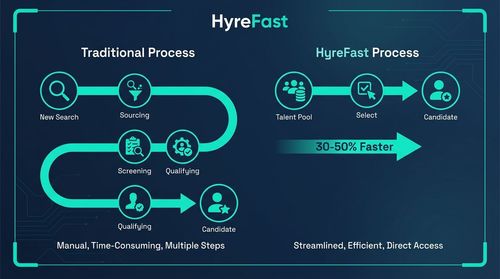
The Core Idea: Instead of treating each requisition as a blank slate, start each search with a head start by tapping into previously engaged, qualified talent.
How It Works: Building and Activating Dynamic Talent Pools
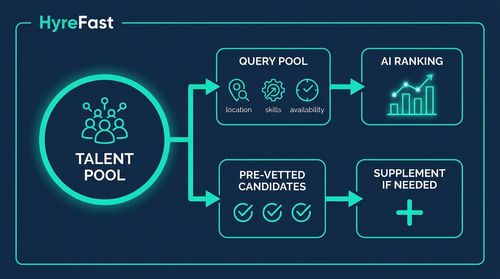
Smart agencies maintain living databases of candidates who have previously applied, engaged positively, or been identified as strong fits—continuously enriched with new data and signals.
- Building the Pool:
- Silver Medalists: Strong candidates from past requisitions who weren't selected but were highly regarded.
- Past Engaged Applicants: Candidates who applied, completed assessments, or spoke with a recruiter but weren't hired for other reasons (e.g., location, timing).
- Referrals: Candidates referred by placed employees or internal networks.
- Updated Profiles: Candidates who have updated their LinkedIn or profile on your career site (indicating active job search).
- Campus & Community Talent: Graduates from specific programs, bootcamp alumni, or members of professional associations you've partnered with.
- The Technology:
- ATS/CRM Segmentation & Tagging: Use your system's core features to categorize candidates by role type, skills, location, engagement level, and availability.
- AI Talent Intelligence: Platforms like Eightfold or Phenom can infer skills from past roles/projects and predict engagement likelihood.
- Data Enrichment: Tools that pull in public data (e.g., from LinkedIn, GitHub) to keep profiles current.
- The Activation Flow: When a new requisition opens:
- Query the talent pool for candidates matching the core criteria (location, basic skills, availability).
- Use AI ranking to surface the strongest matches based on conceptual fit.
-
- Present this pre-vetted pool before launching broad sourcing.
-
- Only supplement with new sourcing if the pool doesn't yield sufficient volume/quality.
- The Impact: For recurring high-volume roles (e.g., monthly BPO hiring, quarterly retail spikes), agencies often find that 30-50% of their qualified shortlist comes from the talent pool—drastically reducing time spent on cold sourcing and initial screening. This also tends to improve candidate quality and engagement, as these individuals already have familiarity with the agency and process.
The Cumulative Impact: How the Phases Combine to Deliver 48-Hour Shortlists
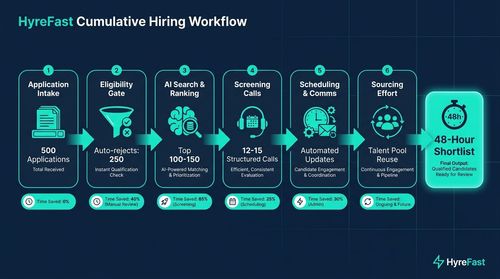
The true power of this approach lies in how the phases work together. It's not about any single tool—it's about the systemic effect of eliminating waste at every stage. Let's walk through a realistic example for a mid-volume requisition (e.g., 500 applications for a customer service or entry-level tech role):
| Stage | Traditional Manual Process | Smart Agency Process | Time Saved |
|---|---|---|---|
| Initial Application Intake | 500 resumes enter manual review queue | 500 applications received | - |
| Automated Eligibility Gate | Not used | 250 candidates fail objective gates (location, availability, certs) and are auto-rejected | ~3.0-4.0 hours (saved from not reviewing 250 clearly unqualified CVs) |
| AI Semantic Search & Ranking | Recruiter starts at top of 500-list and works down | Recruiter focuses on top 100-150 ranked candidates (most conceptually aligned) | ~1.5-2.5 hours (saved from not wading through low-signal noise) |
| Initial Screening Calls | 20-25 calls of 15-20 mins each (ineffective due to lack of structure) | 12-15 calls of 10-15 mins each (structured, focused on fit) | ~1.0-2.0 hours (saved from reducing ineffective talk time) |
| Scheduling & Communication | 3-5 emails/calls per candidate to schedule + manual status updates | Automated scheduling links + trigger-based SMS/email updates | ~2.0-3.0 hours (saved from eliminating admin back-and-forth) |
| Sourcing Effort | Start from scratch for every requisition | Leverage talent pool for 30-50% of shortlist | ~1.0-2.0 hours (saved from reduced cold sourcing) |
| TOTAL TIME FOR SCREENING PHASE | ~12.0-18.0 hours | ~5.5-8.5 hours | ~6.0-10.0 hours saved (50-65% reduction) |
| Note: Times are estimates based on industry benchmarks and internal agency data. Actual savings will vary based on role complexity, volume, and starting baseline. | |||
| With this level of efficiency, delivering a qualified shortlist within 48 hours becomes not just possible—it becomes routine. Even for more complex or specialized roles, the time saved in the screening phase creates a substantial buffer for deeper assessment, client consultation, and unexpected delays. |
Implementation: A Pragmatic, Phased Roadmap
You don't need to implement everything at once. Start where the pain is greatest and build momentum.
Phase 0: Diagnose Your Specific Bottlenecks (Week 1)
- Time Audit: Have recruiters track their time in 15-minute increments for 3-5 days. Categorize: sourcing, resume review, scheduling, calling, admin/client time, break.
- Process Mapping: Diagram your current workflow from application to shortlist. Identify every manual step, handoff, wait time, and decision point.
- Data Dive: Pull reports from your ATS: average time-to-screen, drop-off rates at each stage, source of hire, and recruiter activity metrics.
- Identify the 20% of causes creating 80% of the delay. Is it scheduling? Resume triage? Lack of communication?
Phase 1: Eliminate the Biggest Time Sink (Weeks 2-4)
- Pick One: Based on your audit, choose the single biggest bottleneck (e.g., manual resume review or scheduling).
- Implement the Core Solution:
- If it's resume triage: Implement automated eligibility gates (knockout questionnaire) + AI semantic search.
- If it's scheduling: Deploy an AI scheduler (Calendly, X.ai) + automated communication triggers.
- Measure and Communicate: Track the time saved per requisition and share results with the team. Celebrate the win to build buy-in for further changes.
Phase 2: Build the Communication and Scheduling Engine (Weeks 5-8)
- Layer in Automation: Add automated SMS/email triggers for application receipt, status updates, and interview confirmation.
- Deploy Self-Service Scheduling: Implement batch scheduling links for initial screens.
- Train the Team: Ensure recruiters understand how the new tools work and how their role shifts (e.g., from scheduler to relationship builder).
Phase 3: Optimize the Initial Screen and Rediscover Talent (Weeks 9-12)
- Roll Out Structured Call Guides: Provide templates and practice sessions for knockout-driven screens.
- Integrate Skill Validation: Where relevant, add pre-screen assessments for basic proficiency.
- Activate Talent Pools: Start mining your ATS for silver medalists and past applicants before launching new sourcing.
- Measure Quality Metrics: Track submission-to-interview ratio, hiring manager satisfaction with shortlists, and offer acceptance rates.
Phase 4: Refine, Scale, and Become a Strategic Partner (Ongoing)
- Continuously Improve: Regularly review time metrics, candidate feedback, and hiring manager satisfaction.
- Expand Automation: Look for other repetitive tasks to automate (e.g., offer letter generation, reference checking initiation).
- Shift Recruiter Focus: Use reclaimed time for high-value activities: deep client consultation, proactive talent pool building, candidate coaching, and market intelligence sharing.
- Track Business Outcomes: Measure impact on placement volume, time-to-fill, client retention, and recruiter satisfaction/NPS.
Conclusion: Speed and Quality Are Not Trade-Offs—they’re Synergistic
The belief that you must choose between speed and quality in recruitment is a myth born of inefficient processes. In reality, when you eliminate waste, leverage intelligent automation, and focus recruiter energy on high-signal activities, you don’t just speed up the process—you improve the quality of your shortlists and the experience for both candidates and clients. The agencies that deliver shortlists in 48 hours without compromising quality aren’t sacrificing rigor—they’re enhancing it. They’re using technology to handle the eliminable so that recruiters can spend their time where it truly matters: understanding candidate potential, assessing nuanced fit, and building the relationships that win the war for talent. In 2025 and beyond, the winners in India’s recruitment landscape won’t be the agencies with the most recruiters working the longest hours. They’ll be the ones who have mastered the art of screening smarter—turning what was once a bottleneck into a competitive advantage, one automated workflow, one eliminated inefficiency, and one reclaimed recruiter hour at a time. Start not by working harder, but by working smarter. Your clients, your candidates, and your recruiters will thank you—and your placements will finally reflect the true value of your expertise.