
How to Evaluate 100+ Candidates Without Burning Out Your Recruiting Team
Scale hiring efficiently with structured screening and async interviews without recruiter burnout.
Table of Contents

Introduction
Your recruiting team is drowning. That open headcount isn't going anywhere, but the steady stream of applicants shows no sign of slowing down.
Every morning brings another hundred resumes, another hundred screening calls to schedule, another hundred candidates waiting for a response that takes weeks to come.
The math is brutal: with 500 applicants for a single role, even a 15-minute phone screen translates to 125 hours of interviewer time-the equivalent of three full workweeks for just one position. Something has to give.
And usually, what gives is quality, candidate experience, or your team's sanity (or all three). This is the reality for hiring managers and talent acquisition leaders across India's tech ecosystem.
Whether you're a Series B startup in Bengaluru racing to build a product team, or a global capability centre in Hyderabad scaling up operations, the volume problem is the same. The traditional model of evaluating every candidate through a live conversation simply doesn't scale.
The result? Burnout, inconsistency, and a hiring process that leaks talent at every stage. The good news is that it doesn't have to be this way.
Evaluating hundreds of candidates without destroying your team is not about working harder or pushing your recruiters to the brink. It's about redesigning your process to be intelligent, structured, and sustainable.
This article provides a practical framework for scaling your candidate evaluation-leveraging technology, process design, and smart resource allocation-to handle volume without compromising quality or burning out your team.
The Burnout Reality: Why Traditional Screening Fails at Scale
Before we fix the problem, we need to understand why the traditional approach breaks down so completely.
The core issue is that live, conversational screening is a serial process. One candidate, one conversation, one time slot. It is inherently limited by human availability and attention.
When volume spikes, this model doesn't just struggle-it collapses.
The Quantified Cost of Serial Screening
Let's do the math for a high-volume hiring scenario: imagine you need to fill 20 positions, each attracting 150 applicants. That's 3,000 total candidates.
Even if you only screen the top 30% (900 candidates) with a 20-minute call, that's 300 hours of interviewer time.
That's nearly eight full workweeks of pure screening conversations-time that your senior engineers, hiring managers, and recruiters should be spending on strategic work, not repetitive phone screens.
And this calculation assumes every candidate shows up, is on time, and is prepared. In reality, no-shows, rescheduling, and rushed conversations add another 20-30% overhead.
The Quality Tax: What Happens When Your Team Is Overwhelmed
When recruiters are overwhelmed, two dangerous things happen. First, they cut corners. Questions become inconsistent, evaluations become superficial, and the "vibe check" replaces structured assessment. Second, they delay. Candidates wait days-or weeks-for feedback.
The best candidates, those with the most options, simply accept other offers. You're left screening candidates who couldn't land a job anywhere else.
Research from the Talent Board consistently shows that long wait times and poor communication are the top reasons candidates reject offers or drop out of processes [1].
In India's competitive talent market, where a strong developer or product manager might have three or four offers on the table, the company with the faster, more respectful process wins.
The Human Cost: Recruiter Attrition
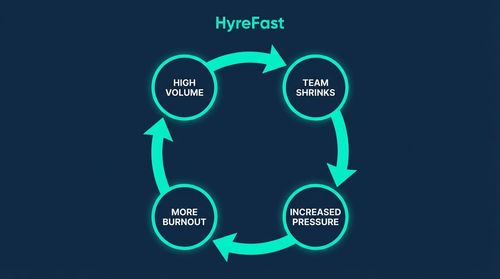
There's also a hidden cost that's often ignored: your recruiting team itself. Talent acquisition has one of the highest burnout rates in any organisation.
The constant pressure to fill roles, manage hiring managers, and treat every candidate with respect while drowning in volume is unsustainable.
The result? Recruiter turnover, which costs companies significantly in lost institutional knowledge, ramp-up time for new hires, and the recruitment itself. It's a vicious cycle: volume increases, team shrinks, remaining recruiters are asked to do more, more burn out.
The Solution: A Tiered, Structured Evaluation Framework
The answer to high-volume hiring is not to power through with sheer willpower. It's to redesign your evaluation process into a tiered, structured funnel that filters candidates efficiently at each stage, reserving expensive human time for only those candidates who truly warrant it.
Tier 1: The Automated Filter (Resume + Skills Assessment)
The first tier should eliminate the largest number of candidates quickly, using objective criteria and automated tools. This is where you apply hard filters and initial competency checks.
- Automated Resume Screening: Use Applicant Tracking System (ATS) filters or AI-powered screening tools to filter based on must-have qualifications (years of experience, specific skills, education requirements). This can reduce the candidate pool by 50-70% instantly.
- Skills Assessments: For technical roles, use automated coding tests or quiz-based assessments. Platforms like HackerRank, Codility, or even custom take-home tests can filter for technical competency before any human time is invested. The key is to set a clear cutoff score and stick to it.
- Application Quality Filters: A simple but effective filter: does the candidate's application show effort? A custom cover letter, a complete profile, relevant project links-these signals correlate with genuine interest and can be used to prioritise the most engaged candidates.
Why this works: This tier is fast, objective, and scalable. It requires zero human time per candidate and eliminates the majority of unqualified applicants before your team invests a single minute.
Tier 2: The Structured Async Screen (Asynchronous Video)
The second tier is where asynchronous video screening shines. After the automated filter, you have a manageable subset of candidates-perhaps 15-20% of the original pool-who meet the basic criteria. Instead of scheduling live calls, you ask them to record responses to 3-5 structured questions.
- Consistent Question Bank: Every candidate for a role answers the same questions. This eliminates the variability of unstructured phone screens and ensures you're comparing apples to apples.
- Asynchronous Review: Your team reviews recordings on their own schedule. They can speed up, pause, rewind, and review transcripts. A manager can evaluate 10 async screens in the time it takes to do three live calls.
- Parallel Evaluation: Multiple team members can review the same candidate simultaneously, enabling faster consensus and reducing bottlenecks.
Why this works: Async video screening decouples the candidate's act of interviewing from the evaluator's schedule. It eliminates scheduling overhead, enables parallel review, and provides richer data than a resume-while still being faster to evaluate than a live call. Research shows that structured async screening can reduce time-to-hire by 40-60% in high-volume scenarios [2].
Tier 3: The Focused Live Interaction
The final tier is the live interview-but now, your team is only meeting with a curated shortlist. This is where you assess what machines can't: cultural fit, nuanced communication, and the ability to think on your feet.
- Structured Interview Format: Even in live interviews, use a structured format with consistent questions and a scoring rubric. This ensures reliability and makes calibration across interviewers possible.
- Panel Format: Where possible, use panel interviews (2-3 interviewers) to gather multiple perspectives in a single session, reducing the total number of interview rounds.
- Focus on High-Impact Assessment: Reserve live time for assessments that truly require human interaction-problem-solving discussions, leadership scenarios, or cultural alignment conversations. Why this works: By the time a candidate reaches this stage, you've already filtered out 90%+ of applicants through objective, automated means. Your team's limited live interview time is spent only on candidates who have demonstrated baseline competency and genuine interest.
Practical Strategies to Protect Your Team
Beyond the tiered framework, there are specific operational strategies that prevent burnout and keep your recruiting engine running smoothly.
1. Batch Processing: The Power of Focus
Instead of screening candidates one by one as applications come in, batch process them. Set aside specific blocks of time-say, Tuesday and Thursday mornings-to focus solely on screening.
Turn off Slack, close email, and power through a batch. This reduces context switching and dramatically improves efficiency. Recruiters who batch process report 30-40% higher throughput compared to continuous, interrupt-driven screening [3].
2. Clear Rubrics and Scorecards: Eliminate Decision Fatigue
Every stage of your funnel should have a clear scoring rubric. What exactly are you evaluating at each stage? What does a "pass" look like? What is an automatic disqualifier? When your team doesn't have to make subjective judgments from scratch for every candidate, decision fatigue drops significantly.
A simple 1-5 scale with behavioural anchors for each competency transforms screening from an exhausting cognitive load into a quick, consistent evaluation.
3. Automated Feedback Loops: Keep Candidates Informed
One of the biggest sources of candidate frustration-and recruiter time waste-is managing candidate communication. Automate it. Set up automated email sequences for each stage: "Thank you for applying," "You've passed to the next stage," "Unfortunately, we've decided to move forward with other candidates."
This keeps candidates informed, reduces inbound inquiries, and protects your team from the emotional labour of delivering bad news individually.
4. Calibration Sessions: Align Your Team
Regular calibration sessions-where your team reviews the same sample candidates and discusses discrepancies-do two things. First, they improve the quality of your hiring by ensuring everyone is applying the same standards.
Second, they reduce individual burden, as reviewers learn from each other and develop shared mental models. Companies that conduct monthly calibration sessions report higher inter-rater reliability and lower regret hiring rates [4].
5. Leverage Data, Not Just Intuition
Track your funnel metrics at every stage. What percentage of candidates pass the resume screen? What percentage fail the skills assessment? Where are candidates dropping out? This data reveals bottlenecks, identifies bias, and helps you continuously improve your process.
It also provides ammunition when you need to push back on hiring managers who want to add "just one more question" to the screening process.
The Technology Stack: Tools That Scale
You don't need to build everything from scratch. A smart technology stack can multiply your team's effectiveness.
| Stage | Tool Category | Purpose |
|---|---|---|
| Resume Screening | ATS with AI screening (e.g., Freshteam, Greenhouse, Lever) | Auto-filter based on keywords, experience, skills |
| Skills Assessment | Coding platforms (HackerRank, Codility) or quiz tools | Objective technical filtering |
| Async Video Screening | Async video platforms (HireVue, VidCruiter, Spark Hire) | Structured video responses, parallel review |
| Live Interviews | Scheduling tools (Calendly) + video platform (Zoom, Google Meet) | Reduce scheduling friction |
| Feedback & Communication | Email automation, candidate portal | Keep candidates informed without manual effort |
| The key is integration. Your ATS should feed into your assessment tool, which feeds into your async screening platform, which feeds into your live interview schedule. A fragmented tool landscape creates more work, not less. |
Real-World Impact: Companies Getting This Right
Theory is useful, but what's the actual impact? Consider these scenarios from the Indian market:
- A Bengaluru Fintech Unicorn: Processing 8,000+ applications per month for customer support roles, they implemented a tiered funnel: automated resume filter (60% reduction), followed by a 10-minute async video screen (another 70% reduction), with live interviews reserved for just 5% of applicants.
- Result: Time-to-hire dropped from 28 days to 12 days, and recruiter screening time per role dropped from 40 hours to 8 hours.
- A Hyderabad IT Services Firm: Hiring 500+ junior engineers annually, they replaced unstructured GDs with a structured async video round assessing communication and problem-solving.
- Result: They eliminated the need for group discussion rounds entirely, reduced interviewer burden by 50%, and improved offer acceptance rates by 15% because candidates appreciated the flexible, respectful process.
Conclusion: Scale Your Hiring Without Scaling Your Suffering
Evaluating 100+ candidates without burning out your team is not about working longer hours or asking your recruiters to be superhuman.
It's about redesigning your process to be intelligent, structured, and sustainable.
Implement a tiered funnel that uses automation and objective filtering for the early stages, reserves human time for high-impact evaluation, and supports your team with the right tools, rubrics, and calibration.
The companies that win the talent war are not the ones with the most recruiters-they're the ones with the smartest processes. Your team deserves a hiring engine that works with them, not against them.
And your candidates deserve a process that respects their time and showcases your company's best side. Both are achievable, if you're willing to rethink the funnel.
References
- Talent Board. "North American Candidate Experience Research Report." 2023.
- HirePro. "Async Screening Efficiency Metrics." 2024.
- Cal Newport. Deep Work: Rules for Focused Success in a Distracted World. 2016.
- Google re:Work. "Guide: Structured Interviewing."