
What Makes a “High-Potential” Candidate? Insights from AI-Based Interviews
What makes a high-potential candidate? Explore how AI-based interviews assess problem-solving, adaptability, and leadership beyond resumes.
Table of Contents

Introduction
The hiring process is undergoing a quiet revolution. On one hand, social media platforms buzz with anecdotes about candidates feeling reduced to data points, and hiring managers expressing fatigue with the sheer volume and inconsistency of applications.
On the other, a growing body of academic research is demonstrating that the traditional tools we’ve relied on-the resume scan, the structured questionnaire, the gut-feeling interview-are profoundly flawed.
They are subjective, prone to unconscious bias, and often poor predictors of who will truly excel in a role. In this context, AI-based interviews are emerging not as a futuristic concept, but as a practical, data-driven methodology to solve a critical business problem: identifying high-potential candidates.
This article will explore the definition of 'high-potential' beyond the buzzword, grounded in insights from recent academic literature.
We will delve into how AI systems are architectured to assess these traits through multi-modal analysis, examine the tangible benefits and inherent challenges of this approach, and offer a clear-eyed perspective for startups and hiring managers looking to adopt these technologies responsibly. The goal is to move from a paradigm of credential-matching to one of potential-prediction.
The Broken Framework of Traditional Hiring

The search for high-potential employees has long been a holy grail for organisations. Sources like Harvard Business Review and Forbes consistently highlight traits like leadership, adaptability, and learning agility.
However, the methods used to find these individuals have not kept pace.
A pivotal study, "How do Software Engineering Candidates Prepare for Technical Interviews?" (arXiv:2507.02068v1), sheds light on a core issue: candidates rarely train in authentic settings, and existing preparation courses fail to adequately bridge the gap.
This leads to a scenario where performance in an artificial, high-stakes interview environment may not reflect true on-the-job capability.
The stress and unpreparedness candidates experience can mask their underlying potential. Furthermore, traditional interviews are notoriously susceptible to cognitive biases. Interviewers may be unduly influenced by a candidate's university, a previous employer's brand, or simple affinity bias-liking someone because they are similar to oneself.
This system systematically overlooks non-traditional candidates and perpetuates homogenous workforces. The problem, then, is twofold: we are using unreliable instruments to measure a complex, multi-faceted construct. We need a more objective, comprehensive, and scalable approach.
Deconstructing 'High-Potential': The Core Traits AI Seeks
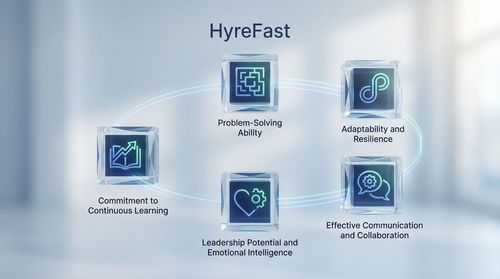
So, what exactly are we measuring?
AI-based systems move beyond the checklist of technical skills on a CV to analyse a synthesis of foundational competencies and adaptive character traits. Based on analysis from industry literature and AI implementation studies, high-potential candidates consistently demonstrate:
- Problem-Solving Ability: This is more than finding the correct answer; it's about the process. AI systems can analyse a candidate's approach to a coding challenge or a case study, evaluating the logic, creativity, and efficiency of their thought process, not just the final output.
- Adaptability and Resilience: How does a candidate handle ambiguity or unexpected hurdles? AI can assess this through scenario-based questions, analysing language for signs of cognitive flexibility versus rigid thinking, and gauging emotional response to simulated pressure.
- Effective Communication and Collaboration: This is assessed through both verbal and non-verbal cues. Natural Language Processing (NLP) models can evaluate the clarity, structure, and persuasiveness of a candidate's speech. In group simulation exercises, AI can analyse turn-taking, influence, and supportive language to gauge collaborative tendencies.
- Leadership Potential and Emotional Intelligence: These are observed through behavioural assessments. AI systems can identify instances where a candidate demonstrates empathy, motivates a simulated team, or navigates interpersonal conflict, providing a more nuanced picture than a simple "Tell me about a time you led a project" question.
- Commitment to Continuous Learning: This trait is gauged by exploring a candidate's curiosity, their approach to past failures, and their self-directed learning initiatives. The depth of explanation and the ability to articulate lessons learned are key indicators.
These traits form a profile that predicts not just whether a candidate can do the job today, but whether they can grow into the roles of tomorrow.
The Architectural Blueprint of an AI Interview System
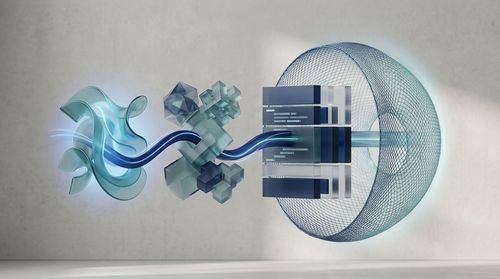
How does an AI system actually conduct this assessment? Let's break down the end-to-end architecture, drawing from systems like "Zara:
An LLM-based Candidate Interview Feedback System" (arXiv:2507.02869v1) and principles from other fields like healthcare AI (e.g., arXiv:2011.06457v1).
A robust AI-interview platform is typically multi-modal, integrating several assessment layers:
-
Behavioural Analysis Layer: This is the core conversational engine, often powered by a Large Language Model (LLM). The candidate interacts with an AI interviewer that can ask dynamic, follow-up questions. The system doesn't just transcribe text; it analyses semantic content, sentiment, and psycho-linguistic cues to assess traits like communication and emotional intelligence.
-
Cognitive Testing Layer: Integrated directly into the flow are standardised cognitive and problem-solving exercises. These can range from logical puzzles to domain-specific technical challenges. The AI analyses the time-to-solution, the sequence of attempts, and the approach, providing a quantitative measure of analytical prowess.
-
Skills Validation Layer: For technical roles, this might involve a live coding environment. The AI evaluates the code for correctness, efficiency, readability, and elegance, going far beyond a simple pass/fail.
-
Bias Mitigation Engine: This is a critical, often separate module. It works to anonymise certain speech patterns or demographic indicators during analysis. It also constantly audits the model's outputs to ensure it is not developing proxies for gender, ethnicity, or age. If an AI is trained on historical data laden with human biases, it will amplify them. Therefore, systems must be designed to actively correct for this.
The output is not a single score, but a rich, multi-dimensional candidate profile. For instance, Zara's system is designed to provide personalised, structured feedback, highlighting strengths and areas for development-a value-add for both the employer and the candidate.
Navigating the Pitfalls: Fairness, Transparency, and Accountability
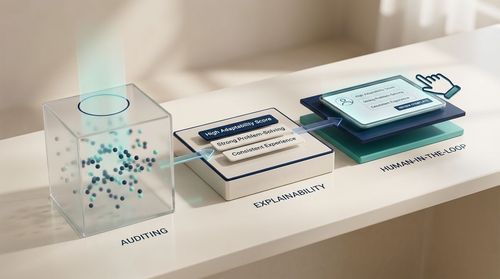
The power of AI in hiring comes with significant ethical and practical responsibilities. The greatest challenge is ensuring fairness. The fear that an AI "black box" might make unjust decisions is valid. Mitigation is a technical and procedural necessity. It involves:
- Regular Audits: Continuously testing the model against diverse datasets to check for discriminatory patterns.
- Explainability (XAI): Developing systems that can explain why a certain assessment was made. For example, "The candidate scored highly on adaptability due to their response to curveball questions X and Y."
- Human-in-the-Loop Design: AI should be used as a decision-support tool, not an autonomous gatekeeper. The final hiring decision should involve a human manager who can review the AI's data-driven insights in a broader context.
Another challenge is candidate experience. The process must feel engaging and respectful, not like an impersonal interrogation. Systems that provide constructive feedback, like Zara, can transform the interview from a stressful test into a valuable developmental experience, improving the company's brand in the talent market.
Conclusion: Synthesising the Human and the Algorithmic

The integration of AI into hiring is not about replacing human judgment but augmenting it with deeper, more objective data. The insights from academic research point to a clear path forward .
- High-Potential is Multi-Dimensional. It is a measurable combination of cognitive ability, behavioural traits, and adaptive skills. AI interviews are uniquely suited to assess this complexity.
- Objectivity is a Designed Outcome. Fairness doesn't happen by accident; it must be engineered into the system through rigorous bias mitigation and transparency measures.
- The Candidate Experience is Part of the Assessment. A well-designed AI interview can reduce candidate stress and provide valuable feedback, assessing resilience and learning agility in real-time.
- AI is a Force Multiplier for Humans. The optimal use case is AI handling the heavy lifting of data analysis, freeing up human managers to focus on strategic fit, cultural alignment, and final judgment calls based on enriched information.
The transition from a traditional to an AI-augmented hiring process is a strategic imperative for organisations seeking a competitive edge in the war for talent. It promises a future where we hire not just for the skills listed on a CV, but for the proven potential to learn, adapt, and lead.
Future Directions
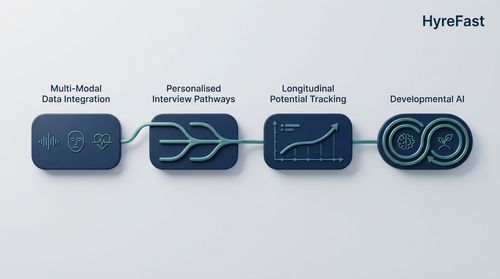
The field of AI-based assessments is rapidly evolving. Based on current research trajectories, we can anticipate several key developments:
- Integration of Advanced Multi-Modal Data: Future systems will more seamlessly combine analysis of voice tonality, facial expressions (where ethical and consented), and bio-signals to create even richer psychometric profiles.
- Personalised Interview Pathways: AI will dynamically adjust interview questions in real-time based on a candidate's previous answers, providing a more tailored and accurate assessment.
- Longitudinal Potential Tracking: The ultimate test of an AI's prediction is on-the-job performance. Future systems will close the loop by correlating interview data with long-term career progression data within the company, continuously improving the model's accuracy.
- Focus on Developmental AI: Tools like Zara hint at a future where AI is used not just for selection, but for continuous employee development, identifying skill gaps and recommending personalised training paths throughout a career.
References
- "Zara: An LLM-based Candidate Interview Feedback System" (arXiv:2507.02869v1)
- "How do Software Engineering Candidates Prepare for Technical Interviews?" (arXiv:2507.02068v1)
- "World Trade Center responders in their own words: Predicting PTSD symptom trajectories with AI-based language analyses of interviews" (arXiv:2011.06457v1)
- "What Makes a High-Potential Candidate?" by Harvard Business Review
- "The Characteristics of High Potential Employees" by Forbes
- "How to Identify and Develop High Potential Employees" by Entrepreneur Magazine