
Resume Screening vs Interview-First Screening
Resume screening vs interview-first screening: discover which candidate screening method works best for high-volume hiring and scalable recruitment.
Table of Contents

Introduction
The debate between resume screening and interview-first screening is more than an academic exercise; it’s a practical dilemma that hiring managers and founders face every time they open a new role.
On professional networks and in industry discussions, a common sentiment echoes: the traditional resume-first process feels broken. It’s seen as a bottleneck that favours polished presentation over raw talent. Yet, the alternative-interviewing candidates before even glancing at their CV-seems resource-intensive and almost recklessly optimistic.
This tension reflects a deeper question: should we prioritise efficiency or depth in our initial candidate evaluation? For startups optimising for growth and established companies aiming for inclusivity, the choice of screening strategy is foundational to building great teams.
The answer, as recent research suggests, is not a binary one but a nuanced balance. This article will explore the technical mechanics and inherent biases of both resume screening and interview-first approaches. We’ll examine the emerging role of AI in parsing resumes, the persistent challenge of algorithmic bias, and practical frameworks for designing a hiring process that is both fair and effective.
The Problem with Traditional Resume Screening: Efficiency at a Cost

Resume screening is the de facto standard for most hiring pipelines.
The process is straightforward: applications pour in, and a human recruiter or an automated system scans each resume for keywords, relevant experience, and educational qualifications. The primary advantage is undeniable scale.
For a role that receives hundreds of applications, it is pragmatically impossible to conduct a full interview with every single candidate. Resume screening acts as a necessary filter.However, this efficiency comes with significant trade-offs. The core limitation is that a resume is a deeply impoverished data source.
It is a curated document, often stripped of the context behind each achievement or career transition. It tells you what someone did, but rarely how they did it, what they learned, or how they overcame challenges.
This lack of context forces screeners to rely on proxies, which introduces bias. Recent academic work has critically examined the biases embedded in automated resume screening.
A 2024 study by Wilson and Caliskan, "Gender, Race, and Intersectional Bias in Resume Screening via Language Model Retrieval," demonstrates how language models used for this task can perpetuate and even amplify societal biases.
If a model is trained on historical hiring data from a non-diverse workforce, it will learn to associate successful candidates with specific patterns of language, educational institutions, or career paths that systematically disadvantage underrepresented groups.
The "keyword bias" is a well-known manifestation of this; a candidate who has the exact terminology from the job description on their resume may be ranked higher than a candidate with equivalent but differently phrased experience.
Furthermore, a 2021 paper by Parasurama and Sedoc, "Degendering Resumes for Fair Algorithmic Resume Screening," highlights how even subtle gendered information within the text of a resume can influence algorithmic decisions.
Their proposed solution involves techniques to scrub gendered cues from resumes before processing, a technical mitigation that acknowledges the profundity of the problem. Resume screening, therefore, while efficient, risks creating a homogenous pipeline by over-indexing on a narrow set of signals.
The Interview-First Paradigm: Prioritising Human Connection
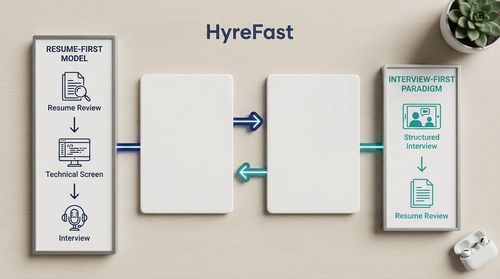
In contrast, the interview-first screening model inverts the traditional workflow.
The first step is a structured conversation, typically a brief phone or video screen, before the resume is reviewed in detail. The goal is to assess a candidate’s communication skills, problem-solving approach, and cultural fit directly.
The most significant advantage of this approach is the rich, contextual data it provides. You get a dynamic sense of the person behind the application.
How do they articulate their thoughts? How do they react to questions?
This can be particularly valuable for roles where soft skills, creativity, and collaboration are as critical as technical credentials. It also proactively improves the candidate experience.
Applicants often report feeling more valued when given the opportunity to speak directly with a team member early in the process, rather than feeling like a faceless entry in a database.
Proponents argue that this method can reduce certain types of bias. By focusing on a real-time interaction, the initial screening becomes less about the prestige of past employers or the perfect keyword match and more about observable, demonstrable competencies.
It can help uncover potential that a resume might obscure-for instance, a self-taught developer with a non-traditional background who can brilliantly explain a complex project.
However, the interview-first model is not a panacea. Its primary drawback is scalability. Conducting even a 15-minute screening call for 200 applicants represents 50 hours of dedicated time from your team.
For a small startup, this is a massive resource drain that can slow down hiring critically. Furthermore, interviews introduce their own forms of subjectivity and bias. Unstructured interviews, where each conversation follows a different path, are notoriously poor predictors of job performance.
Interviewers can be swayed by charisma, similarity to themselves (affinity bias), or a single strong or weak answer (the halo/horns effect). Without rigorous standardisation, the interview-first approach can simply replace one set of biases with another.
The Rise of AI and LLMs in Resume Screening: A Double-Edged Sword

The field of resume screening is rapidly evolving with the integration of sophisticated artificial intelligence, particularly Large Language Models (LLMs).
A 2024 framework proposed by Gan, Zhang, and Mori, "Application of LLM Agents in Recruitment: A Novel Framework for Resume Screening," illustrates the potential.
Instead of simple keyword matching, their system uses LLM agents to perform a more nuanced analysis, potentially understanding the context of achievements and matching skills to job requirements with greater semantic understanding.This represents a significant technical advancement.
An LLM-powered system could, in theory, read between the lines of a resume, inferring competencies from project descriptions in a way that old-fashioned parsers could not. This could help mitigate the "limited context" problem by doing a better job of interpreting the information that is present.
However, this powerful technology also amplifies the risks highlighted in the bias research. Because LLMs learn from vast datasets of human-generated text, they inherit the biases present in that data.
An LLM agent tasked with resume screening might make correlations that are statistically plausible from its training data but are deeply unfair-for example, associating leadership roles more strongly with male-coded language.
The challenge, therefore, shifts from building a capable system to building a fair one. Techniques like the "degendering" approach mentioned earlier, along with rigorous bias auditing and fairness constraints, become non-negotiable components of a responsible AI screening tool.
Designing a Hybrid Screening Strategy: A Practical Framework
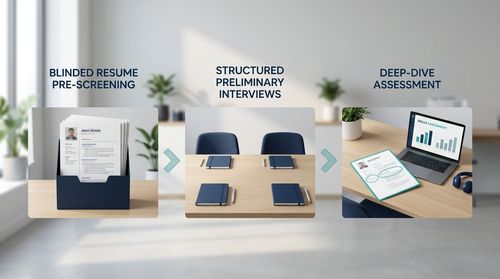
For most organisations, a pragmatic hybrid approach that leverages the strengths of both methods while mitigating their weaknesses is the most viable path forward. The goal is to create a staged funnel that balances efficiency with depth.
Stage 1: Light-Touch, Blinded Resume Pre-Screening
Instead of abandoning resume screening, optimise it for fairness. Use anonymised resumes where names, universities (which can be proxies for socioeconomic status), and graduation years are removed. If using an AI tool, ensure it is one that has been audited for bias and incorporates fairness metrics.
This first stage is not about finding the perfect candidate, but about filtering out applications that clearly lack the fundamental, non-negotiable qualifications for the role. The threshold here should be set deliberately low to avoid false negatives.
Stage 2: Structured Preliminary Interviews
The candidates who pass the initial screen should then enter a structured interview phase. This is not a free-form chat. The "structured" element is crucial. Every candidate should be asked the same set of core questions focused on key competencies for the role. Use a clear scoring rubric to evaluate answers consistently across interviewers.
This combines the human connection of the interview-first model with the standardisation needed to reduce subjective bias. The objective of this stage is to assess communication, problem-solving, and cultural add.
Stage 3: Deep-Dive Assessment
For the final shortlist, the resume now becomes a valuable tool again. With a smaller, highly-qualified pool, hiring managers can conduct a detailed resume review informed by their positive initial impression from the interview.
This is the time to delve into the specifics of their experience, using the resume as a guide for a more in-depth technical interview or a skills-based assessment. This final stage combines the depth of contextual understanding with the concrete evidence of past achievement.
Conclusions and Future Directions
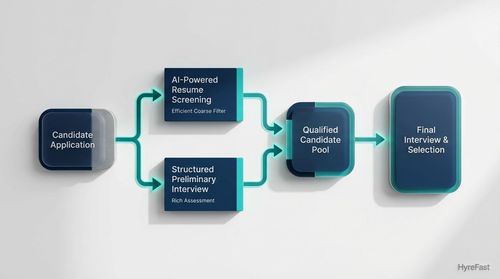
The choice between resume and interview-first screening is not about picking a winner. It is about strategically sequencing different evaluation methods to build a robust hiring pipeline.
- Resume screening is efficient but brittle. Its value increases when augmented by AI and when stringent blinding techniques are applied to mitigate inherent biases. It is best used as a coarse filter.
- Interview-first screening is rich but resource-heavy. Its predictive power increases dramatically when structured rigorously. It is ideal for assessing soft skills and potential that a resume cannot capture.
- A hybrid model offers a balanced path. By combining a fair, automated initial screen with a structured preliminary interview, organisations can efficiently narrow the candidate pool while prioritising human connection and reducing bias.
Future research will likely focus on making AI-based screening more transparent and fair.
Explainable AI (XAI) techniques could allow systems to not only score a resume but also explain why, allowing humans to audit and correct for bias.
Furthermore, we may see more integrated platforms that seamlessly combine LLM-powered resume analysis with structured interview tools, creating a more holistic and data-driven candidate evaluation workflow.
For now, the most effective strategy remains a human-centric process thoughtfully supported by technology, not replaced by it.
References
- Wilson, Kyra, and Aylin Caliskan. "Gender, Race, and Intersectional Bias in Resume Screening via Language Model Retrieval." (2024). ArXiv.
- Parasurama, Prasanna, and João Sedoc. "Degendering Resumes for Fair Algorithmic Resume Screening." (2021). ArXiv.
- Gan, Chengguang, Qinghao Zhang, and Tatsunori Mori. "Application of LLM Agents in Recruitment: A Novel Framework for Resume Screening." (2024). ArXiv.