
The Cost of Manual Screening
Discover the real cost of manual candidate screening for recruitment agencies, including recruiter time, delayed placements, and lost revenue.
Table of Contents

Introduction
When a single open role can attract hundreds of applications overnight, the initial sift through CVs becomes a monumental task. On professional networks and in industry forums, hiring managers and startup founders often voice a quiet frustration: the hiring process is a black hole of time. The conversation has shifted from simply finding candidates to managing the overwhelming volume of them.
Manual screening-the foundational step where a human reviewer evaluates each application against role requirements-is at the heart of this operational strain. While it feels like a necessary, albeit tedious, part of building a team, the true expense is often misunderstood. It’s not merely the hours logged; it’s the cumulative impact on speed, quality, and the business's bottom line.
In today's competitive talent market, especially for high-volume roles in tech, retail, and customer service, efficiency in hiring is not a luxury-it's a strategic imperative. For a developer in Bangalore scaling a team or a founder in San Francisco managing burn rate, understanding the real cost of manual processes is the first step toward building a more agile and effective recruitment function.
This article will break down the multi-faceted costs of manual screening, provide a framework for calculating its true financial impact, and explore how technological interventions are changing the calculus for modern organisations.
The Visible Tip of the Iceberg: Direct Labour Costs

At its most basic, manual screening is a human-centric activity. A recruiter or hiring manager opens each application, scans the resume for keywords, education, and experience, and makes a preliminary yes/no decision. The direct cost calculation is straightforward, yet often alarming when quantified.
The formula hinges on a few key variables, as outlined in general business analyses [1, 2]:
- Number of Applications: For a typical frontline or high-volume role, this can easily range from 200 to 500 applicants.
- Time per Application: Conservative estimates place the average screening time between 2 to 5 minutes per resume. This includes opening the document, parsing the information, and logging the decision.
- Labour Costs: Using an average fully-loaded cost (including salary, benefits, and overhead) for a recruiter or hiring manager, this can range from $50 to $100 per hour.
A simple calculation for a role with 300 applicants reveals the immediate financial outlay.
If a recruiter spends 3 minutes per resume at an hourly cost of $75, the total direct labour cost for screening is:
300 applications * (3 minutes/60 minutes) * $75/hour = $1,125
This is a tangible, visible cost that appears on the balance sheet. It's the line item that finance teams see. However, this $1,125 is merely the entry fee. The far greater costs lie hidden beneath the surface.
The Hidden Depths: Indirect and Opportunity Costs
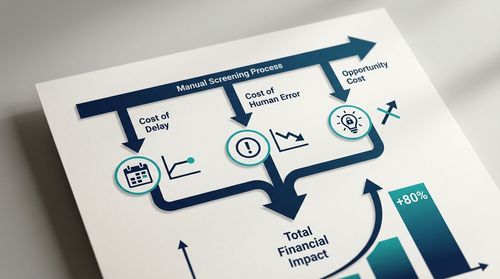
The true financial impact of an inefficient manual screening process is found in the costs you don't see on a timesheet [3, 4].
These indirect costs are often multiples of the direct labour expenditure and can cripple a company's agility.
1. The Cost of Delay
Every day a position remains vacant represents lost productivity and potential revenue loss. Manual screening is slow. With hundreds of applications to review, it can take days or even weeks to simply identify a shortlist of qualified candidates.
This delay has a cascading effect: team members are overworked covering the gap, project timelines slip, and revenue-generating activities are stalled. For customer-facing roles, the impact on service quality and revenue can be immediate and significant.
2. The Cost of Human Error and Inconsistency
Human reviewers suffer from fatigue, bias, and inconsistency. After the 50th resume, concentration wanes.
A promising candidate buried at the bottom of the pile might be glossed over.
Unconscious bias can lead qualified candidates from non-traditional backgrounds to be overlooked. This inconsistency reduces the overall quality of hire.
A poor hiring decision, which can stem from a rushed or biased screening process, is extraordinarily expensive-costing up to 30% of the employee's first-year earnings in re-hiring and training expenses.
3. The Opportunity Cost of Recruiter Time
When recruiters are buried in administrative screening, they are not performing higher-value strategic work.
This includes engaging with top-tier passive candidates, building talent pipelines, improving the employer brand, and conducting more in-depth interviews. This represents a massive opportunity cost.
The organisation is paying a skilled professional to perform a repetitive, transactional task that could be automated, preventing them from contributing more strategically to the company's growth.
Industry analyses, such as those from CloudApper AI Recruiter, suggest that these hidden costs can push the total financial impact of manual screening to between $30,000 and $50,000 annually per position in frontline recruiting [3, 4].
This figure accounts for the cumulative effect of delays, errors, and lost productivity.
A Framework for Calculating Your Own Costs
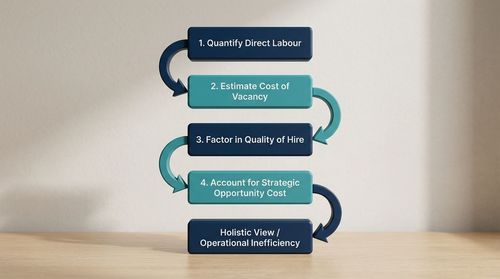
To move from general estimates to a precise understanding, organisations can build their own cost model. This involves looking beyond the direct labour calculation and incorporating the hidden factors.
-
Quantify Direct Labour: Use the formula above: (Number of Applications) x (Time per Application in Hours) x (Fully-Loaded Hourly Rate of Screener).
-
Estimate Cost of Vacancy (COV): Calculate the average revenue per employee per day (Total Revenue / Number of Employees / 260 working days). Multiply this by the number of additional days a manual screening process adds to your time-to-hire. For example, if automation could shorten the screening phase by 5 days, the saving is (Revenue per Employee per Day) x 5.
-
Factor in Quality of Hire: While harder to quantify, consider the potential cost of a bad hire. Estimate the percentage risk of a bad hire increasing due to screening fatigue and multiply that by the average cost of a bad hire for your organization.
-
Account for Strategic Opportunity Cost: Estimate the percentage of time recruiters spend on manual screening. What strategic initiatives could they pursue if 90% of that time were freed up [4]? Assign a potential value to those initiatives.
This holistic view transforms manual screening from an accepted overhead into a significant operational inefficiency-and a prime candidate for optimisation.
The Automation Alternative: Re-allocating Human Intelligence

The conversation inevitably turns to technology, specifically AI and automation, as a means to mitigate these costs. The promise is not to replace human judgement but to augment it. Automation tools can handle the initial, high-volume sifting based on predefined, objective criteria. The stated benefits are compelling [4]:
- Time Savings: Automating the initial screening can free up to 90% of the time recruiters spend on this task.
- Speed: Screening can be reduced from days to hours or even minutes, drastically cutting the time-to-hire and the associated cost of vacancy.
- Consistency and Reduced Bias: Automated systems apply the same rules to every application, ensuring a fair and consistent first-pass filter, thereby mitigating unconscious human bias.
- Scalability: An automated system can handle 50 or 5000 applications with the same efficiency, allowing recruitment efforts to scale without a linear increase in cost. The key is to view automation as a way to re-allocate human intelligence.
By allowing machines to handle the repetitive filtering, human recruiters can focus on what they do best: building relationships, assessing cultural fit, and selling the opportunity to the most promising candidates.
This shifts the recruiter's role from administrator to strategic partner.
Implementing Change: A Pragmatic Approach

For a startup or hiring manager convinced of the cost, the path forward requires careful planning. A sudden, wholesale change is rarely effective. A more pragmatic approach is recommended:
-
Pilot on High-Volume Roles: Begin with the areas of greatest pain-roles that consistently attract hundreds of applicants. This is where the return on investment will be most immediate and measurable.
-
Define Clear, Objective Screening Criteria: Work with hiring managers to establish the non-negotiable skills and qualifications for a role. These criteria form the basis for any automated screening rule set.
-
Choose a Tool That Fits Your Workflow: The market offers everything from simple resume parsers to sophisticated AI-driven conversational screeners. The choice should be guided by your specific needs, volume, and existing tech stack.
-
Monitor and Refine: Use the pilot programme to track key metrics: time-to-fill, cost-per-hire, and quality-of-hire. Use this data to refine the process and build a case for broader implementation.
The goal is not to create a fully autonomous hiring process but to create a more efficient and effective human-led one.
Conclusions

- The True Cost is Holistic: The direct labour cost of manual screening is just the tip of the iceberg. The greater impact lies in hidden costs like delays, errors, and the lost opportunity for strategic recruitment work, which can total $30,000-$50,000 annually per position [3, 4].
- Human Fatigue is a System Failure: Relying solely on humans for high-volume, repetitive screening tasks inevitably leads to fatigue, inconsistency, and bias, degrading the quality of the entire hiring process.
- Automation is an Augmentation Tool: The most effective use of technology is not to replace recruiters but to free them from administrative burdens, allowing them to focus on high-value interpersonal aspects of hiring.
- Data-Driven Decision Making is Key: Building a simple cost model that includes direct and indirect factors is essential for making a compelling business case for process change.