
The Hidden Bottleneck in Every Recruitment Agency: First-Round Interviews
AI-first interviews eliminate scheduling delays, improve screening accuracy, and remove hiring bottlenecks to accelerate time-to-hire and candidate experience.
Table of Contents

Introduction
Most founders, recruiters, and agencies don’t realise this because the problem hides in plain sight: the first-round interview. On paper, it feels necessary. In reality, it is the most expensive and least reliable part of the hiring process.
A 2026 report confirms that interview scheduling is the single biggest bottleneck in hiring, quietly costing you top candidates, recruiter productivity, and credibility.
This matters right now because every recruitment agency is chasing speed and quality, yet the first round remains a black box of delays and misalignment.
In this article, we will unpack why the first-round interview is a hidden bottleneck, explore research-backed solutions from recent arXiv papers, and lay out a practical system to unclog it.
The Hidden Bottleneck Defined
The first-round interview is the stage where candidates accumulate due to slow movement or low conversion rates. Multiple sources identify it as the primary choke point.
One industry analysis states: “Most founders, recruiters, and agencies don’t realize this because the problem hides in plain sight: the first-round interview. On paper, it feels necessary. In reality, it’s the most expensive and least reliable part of the hiring process.”
The cost comes from unstructured conversations, inconsistent interviewer training, and poor intake. When the hiring manager’s real needs are not clarified before the first round, candidates are screened against the wrong criteria. This wastes time and creates a backlog.
The reliability issue is equally damaging: unstructured first rounds produce high variance in assessments, leading to false positives and false negatives.
Why It Remains Hidden
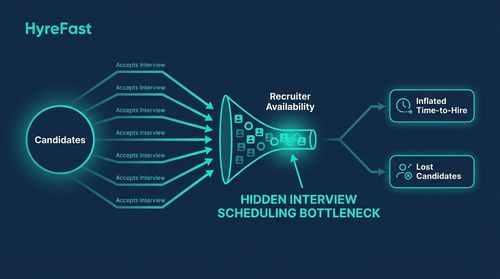
Teams focus on sourcing volume or offer negotiations while ignoring the scheduling and quality issues in the first round.
The bottleneck is embedded in a seemingly routine step, so it escapes attention. A 2026 report notes: “For most organizations, interview scheduling is the single biggest bottleneck in hiring. And it’s quietly costing you top candidates, recruiter productivity, and credibility.”
The arXiv paper Interview Hoarding (2102.06440) analyses a matching market where applicants can accept more interview invitations than employers offer. This “interview hoarding” harms matched participants and reduces overall market efficiency.
In recruitment agencies, candidates schedule multiple first-round slots but recruiters cannot accommodate them, creating a queue that inflates time-to-hire. The problem is hidden because it looks like candidate enthusiasm, but it is actually a structural imbalance.
Research-Backed Solutions
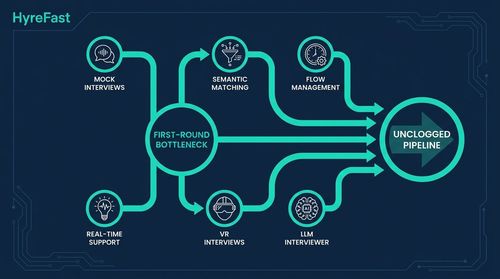
Recent arXiv papers provide a toolkit to diagnose and eliminate the first-round bottleneck. Each addresses a different facet of the choke point.
- EZInterviewer (2301.00972) learns from real recruiter-candidate dialogues to generate realistic mock interviews. By reducing preparation gaps, it cuts the time recruiters spend re-explaining basics and lowers the variance that stalls scheduling. This is a direct attack on the first-round delay bottleneck.
- The Algorithmic Barrier (2601.14534) formalises how rigid keyword-based screening creates “artificial frictional unemployment” – high vacancy rates coexist with long unemployment because qualified candidates are filtered out before they ever reach a human interviewer.
The paper shows that semantic-matching models dramatically improve recall without losing precision, suggesting a way to unclog the first-round filter that currently wastes recruiter time on false negatives.
- InterFlow (2602.06396) introduces an AI-powered visual scaffold that helps interviewers manage flow, track time, and surface follow-up points in real time. By reducing interviewer cognitive load and keeping conversations on track, InterFlow shortens each first-round session and makes scheduling more predictable.
- Interview AI-ssistant (2504.13847) supports interviewers during both preparation (question generation, candidate briefing) and execution (real-time suggestion, rapport-maintenance). Early studies show reduced preparation time and higher consistency across interviewers, which cuts the variability that causes first-round backlogs.
- VR Job Interview Using a Gender-Swapped Avatar (2307.04247) examines how a gender-swapped avatar in VR interviews affects applicant anxiety and recruiter perception. The study finds reduced applicant anxiety and highlights VR as a scalable platform for first-round screening, offering a way to run many parallel, bias-aware interviews without the usual scheduling constraints.
- AI Conversational Interviewing (2410.01824) shows that large language models can conduct scalable, conversational interviews that yield data quality comparable to human interviewers. Deploying an LLM as the first-round interviewer eliminates human-scheduling limits, runs interviews 24/7, and provides consistent scoring – directly removing the human-driven bottleneck.
System Flow for Unclogging
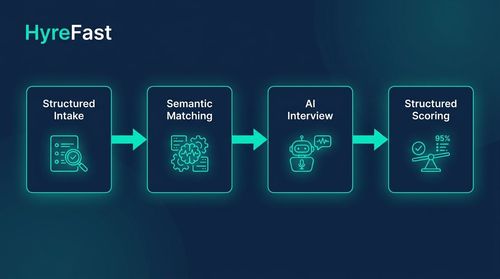
A practical system to unclog the first-round bottleneck combines structured intake, semantic screening, and asynchronous or AI-driven interviews.
- Structured intake framework: Use historical hiring data to define clear requirements before the first interview. This ensures conversations are focused and relevant. Poor intake conversations are a root cause of misaligned first rounds.
- Semantic matching: Move beyond keyword-based screening to context-aware models. The Algorithmic Barrier paper shows this improves recall without losing precision, reducing false rejections and improving first-round quality.
- Asynchronous video or AI interview: Platforms that allow candidates to record responses to role-specific prompts eliminate scheduling delays. The Interviewing Matching paper (2305.11350) provides theoretical guarantees that a well-designed cap on interviews per side prevents the bottleneck from exploding. Asynchronous tools effectively impose that cap.
- Structured scoring and feedback: Use tools like InterFlow or Interview AI-ssistant to ensure consistency across interviewers. This reduces the variance that causes backlogs and improves decision quality.
Challenges and Mitigations
Implementing these solutions comes with real-world friction points. Bias in AI models is a primary concern. The VR paper shows that gender-swapped avatars can reduce applicant anxiety, but algorithmic bias must be actively monitored. Mitigation strategies include regular audits of semantic matching models and using diverse training data.
Candidate experience is another challenge. Asynchronous interviews can feel impersonal. The EZInterviewer approach of providing mock interviews helps candidates prepare, improving their experience. For high-touch roles, a hybrid model where an AI conducts the first round and a human reviews the recording may strike the right balance.
Cost of implementation varies. Semantic matching and LLM-based interviewing require infrastructure investment. However, the Interview Hoarding paper suggests that even simple caps on interview slots can improve efficiency at low cost. Startups should start with structured intake and asynchronous tools before investing in advanced AI.
Alternatives and Trade-offs
Optimising for speed may increase cost. Choose asynchronous AI interviews when you have high volume and standardised roles. Use human-led structured interviews when the role requires nuanced judgement or cultural fit.
The trade-off is between throughput and depth. If your constraint is budget, start with structured intake and a simple cap on first-round slots. If your constraint is time, deploy an LLM-based conversational interviewer.
The AI Conversational Interviewing paper demonstrates that LLMs can match human data quality, making them a viable first-round option for most roles.
Conclusions
- The first-round interview is the most expensive and least reliable part of hiring, yet it remains hidden because teams focus on sourcing and offers.
- Research from arXiv shows that semantic matching, AI-assisted interviewing, and structured caps can directly unclog the bottleneck.
- Academic findings align with industry sentiment: scheduling delays and poor intake are the root causes, and both can be addressed with technology.
- The street view confirms that agencies lose candidates and credibility due to first-round inefficiencies; the academic view provides evidence-based solutions.
Future Directions
- Longitudinal studies on candidate acceptance of AI-led first-round interviews are needed to understand long-term experience impacts.
- Bias mitigation in semantic matching and LLM-based interviewing remains an open research area, especially for underrepresented groups.
- Integration of these tools with existing ATS platforms will determine adoption speed; research on interoperability is sparse.
- The combination of VR and AI for immersive, bias-aware first-round screening is a promising frontier that requires more scalability studies.
Schedule a walkthrough: Book Demo