
The Hidden Cost of a Bad First-Round Interview (And How to Fix It)
Improve first-round interviews to reduce hiring costs, bias, and candidate drop-offs.
Table of Contents

Introduction
That first conversation with a candidate is often treated as a low-stakes formality. A quick call, a vibe check, a box to tick before the "real" interviews begin.
In our fast-paced hiring environments, especially in India's tech hubs, this mindset is not just common-it's dangerously flawed. A poorly conducted first-round interview isn't a minor inefficiency; it's the cracked foundation of your entire talent pipeline.
The true cost extends far beyond the 30 minutes wasted. It's a silent, compounding drain on your finances, your employer brand, and your ability to hire great people.
This article pulls back the curtain on these hidden costs, grounding them in data from talent boards and organisational psychology.
More importantly, we'll move from diagnosis to a practical, battle-tested framework for fixing it-one that balances the need for speed and scale with the non-negotiable demands of fairness and quality.
The Multi-Dimensional Cost of a Broken First Round
When we talk about cost, most people think of the recruiter's hourly rate. That's just the visible tip of the iceberg. The real impact is a cascade of direct and indirect losses that erode your hiring engine from within.
The Direct Financial Drain
Let's start with what's measurable. A flawed first round creates two expensive problems: advancing the wrong people and losing the right ones.
- Low Signal-to-Noise Ratio: Unstructured screens let unqualified candidates through, wasting the time of senior staff in subsequent rounds. Each live interview can cost $500–$1,500 in fully-loaded interviewer time [1].
- The Great Candidate Drop-Off: A disorganised or disrespectful first experience causes strong candidates to self-select out. Research indicates 60% of candidates withdraw due to poor communication in early stages [2]. Replacing that lost talent means restarting sourcing, adding $3,000–$5,000 in agency or advertising costs per role [3].
- The Bottleneck Tax: Inefficient screening extends time-to-hire. For a critical role, every extra day vacant can cost $500–$1,000 in lost productivity [4].
The Silent Killer: Employer Brand Erosion
Your interview process is a public audition of your company culture. A bad first impression doesn't just lose one candidate; it amplifies through networks.
- A CareerBuilder study found 72% of candidates who had a negative interview experience shared it online or directly with others [5].
- In tight-knit talent markets like Bengaluru or Hyderabad, word spreads with astonishing speed. A reputation for chaotic or biased interviewing makes future hiring exponentially harder and more expensive.
The Most Expensive Outcome: Quality-of-Hire Degradation
This is the ultimate hidden cost. A bad first filter fails in two ways: it lets poor fits through and screens strong ones out due to bias or irrelevant questioning.
- The Society for Human Resource Management (SHRM) estimates a bad hire can cost 5–10 times their annual salary when you factor in recruitment, onboarding, severance, and lost productivity [6].
- Even a mediocre hire-someone who underperforms but isn't fired—drags down team velocity and morale for months.
Systemic Risks: Bias Amplification and Interviewer Burnout
Unstructured first rounds are breeding grounds for unconscious bias. When interviewers "wing it," they open the door to discrimination based on gender, educational background, accent, or alma mater.
In India's diverse landscape, this can inadvertently systemically favour candidates from certain regions or socio-economic strata, creating inequity and legal risk under acts like the Equal Remuneration Act, 1976 [7].
Simultaneously, recruiters and hiring managers stuck in endless, repetitive, and unproductive screens suffer decision fatigue. This chronic frustration is a known driver of burnout and attrition within talent acquisition teams, creating a costly cycle of re-hiring your own recruiters.
Root Causes: Why Do So Many First Rounds Fail?
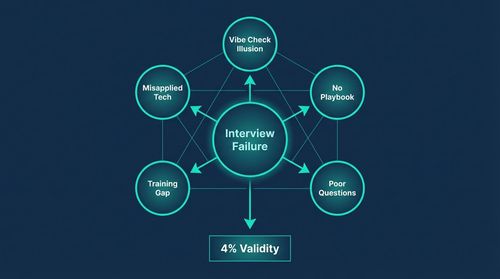
Understanding the cost is step one. To fix it, we must diagnose why these failures are so persistent. The causes are systemic, not personal.
- The Illusion of the "Quick Chat": The first round is often misclassified as a "vibe check" rather than a structured competency screen. This leads to inconsistent questions, over-reliance on gut feeling, and evaluations based on charisma rather than capability.
- The Lack of a Playbook: The most common flaw is the absence of standardisation. Interviewers ask whatever comes to mind, making it impossible to compare candidates fairly. Meta-analyses show unstructured interviews have a validity coefficient of ~0.20, meaning they explain just 4% of job performance variance [8].
- Poor Question Design: Clichés like "Tell me about yourself" or "What's your greatest weakness?" are easily gamed and reveal little about actual on-the-job behaviour. They advantage candidates who are good at interviewing, not necessarily good at the job.
- The Training Gap: Most interviewers-especially hiring managers-are promoted for their technical skills, not their assessment abilities. They receive little to no training in behavioural interviewing, bias mitigation, or calibrated scoring.
- Misapplied Technology: Tools like asynchronous video screening, when implemented without structure or proper training, just automate bad habits. Worse, over-relying on opaque "AI fit scores" can bake algorithmic bias into the process [9].
The Fix: A Four-Pillar Framework for a High-Signal First Round
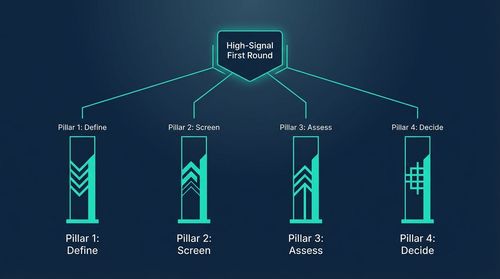
Fixing the first round isn't about adding more steps or buying a magic-bullet tool. It's about disciplined process redesign. This framework, proven in high-volume Indian and global companies, transforms the first round into a reliable, fair, and efficient filter.
Pillar 1: Define What You're Actually Screening For
Start with the job, not the interview. Conduct a focused job analysis to identify:
- 3–5 Non-Negotiable Competencies: What truly predicts success here? (e.g., for a support role: problem-solving, communication, resilience).
- Clear Deal-Breakers: Must-have basics (e.g., proficiency with a specific tool).
- What's Out of Scope: Explicitly state what you are not assessing in this round (e.g., deep technical architecture for a developer-save it for later). This clarity prevents scope creep and ensures every minute of the interview serves a purpose.
Pillar 2: Build a Structured, Behavioural Interview Guide
Replace the unstructured chat with a calibrated script. For each competency, design 1–2 behavioural or situational questions using the STAR (Situation, Task, Action, Result) framework as a guide.
Example for "Problem-Solving":
"Tell me about a time you faced an unexpected technical blocker in a project. What was the situation, what specific actions did you take, and what was the outcome?" Design Principles:
- Consistency is Key: Same questions, same order, same time limits for every candidate.
- Past Over Hypotheticals: "What did you do?" is more predictive than "What would you do?"
- Pilot Test: Run questions by high performers in similar roles to ensure they elicit useful evidence.
Pillar 3: Leverage Technology to Enforce Fairness, Not Replace Judgement
Technology is a force multiplier for structure when used wisely. The goal is to augment human judgement, not automate it away.
- Asynchronous Video Screening (Structured): For high-volume roles (>100 applicants), this is transformative. It enforces identical questions and timing for all, eliminates scheduling bias, and allows for parallel review. Crucially: Use platforms that provide transcripts and highlights to aid human review, but avoid those that output opaque, unvetted "AI scores" [9].
- Integrated Scoring Rubrics: Use a simple 1–5 scale for each competency, with clear behavioural anchors. What does a "3" in communication look like versus a "5"? This turns subjective impressions into comparable data.
- Feedback Enforcement: Choose tools that require structured feedback against the rubric before a candidate can be advanced, preventing lazy "gut feel" evaluations.
Pillar 4: Train, Calibrate, and Hold Interviewers Accountable
No process works without skilled people to run it. This requires investment:
- Mandatory Interviewer Training: Cover behavioural interviewing techniques, common biases (similarity, contrast, halo effects), and how to use the scoring rubric.
- Regular Calibration Sessions: Have interviewers score the same sample interview independently, then discuss discrepancies. This aligns standards and dramatically improves reliability. Companies like Google have found this increases inter-rater reliability by 25%+ [10].
- Track Quality Metrics: Monitor feedback completeness, rubric adherence, and time-to-feedback. Make this part of performance conversations.
Real-World Impact: Proof That the Framework Works
Theory is compelling, but does this work under the pressure of real hiring? Data from Indian companies says yes.
- A Bengaluru SaaS Unicorn: Facing 5,000+ monthly applications and a 40% drop-off rate from unstructured phone screens, they implemented structured async video screening with a behavioural rubric.
Results: Time-to-hire reduced from 21 to 9 days, qualified candidate advance rate increased by 35%, and hiring manager satisfaction jumped from 3.2/5 to 4.6/5 [11].
- A Hyderabad GCC: Inconsistent technical screens (some managers asked deep algorithms, others chatted about hobbies) led to poor predictions. They replaced them with a structured async round focused on communication and problem-solving.
Results: Live interview-to-offer ratio improved from 1:4 to 1:2.2, and time senior engineers spent on screening dropped by 65% [12].
- A Mumbai BFSI Firm: Unstructured rounds were inadvertently favouring candidates from elite metros and colleges, hurting diversity goals. They implemented structured async screening with blind review (hiding demographics initially).
Results: Hires from Tier-2/3 cities increased by 50% in six months, with equivalent promotion rates across groups [13].
Choosing Your Tool: A Practical Trade-Off Guide
| Tool/Approach | Best For | Avoid When | Key Trade-Off |
|---|---|---|---|
| Structured Async Video Screening | High-volume roles (>100 apps), geo-dispersed teams, roles requiring strong communication (sales, support). | Assessing deep technical skills, evaluating nuanced cultural fit in very small teams, very low-volume hiring. | Gains massive scale and consistency; may lose some spontaneity. Mitigate by saving dynamic probing for live rounds. |
| Structured Live Screen (Phone/Video) | Low-to-medium volume, roles where initial rapport is critical (leadership, client-facing), when you need to probe a resume in real-time. | High-volume hiring, when interviewers are untrained. | Allows dynamic follow-up but is hard to scale consistently and is vulnerable to scheduling bias. |
| Automated Skills Assessments | Technical roles where a hard skill is the primary first filter (coding, data analysis). | Roles where communication, problem-solving articulation, or motivation are key. | Excellent for objective skill measurement; says nothing about how a candidate thinks or collaborates. |
Conclusion: Your First Round is Your Strategic Foundation
The first-round interview is not a disposable step. It is the foundation of your hiring process.
A cracked foundation, marked by inconsistency, bias, and disrespect, undermines everything built upon it-no matter how robust your later stages or how strong your employer brand.
The hidden costs-wasted money, damaged reputation, poor hires, team burnout-are real and measurable. But they are also entirely preventable.
The fix requires no magic, only discipline: define what matters, ask questions that reveal it, score answers consistently, train your assessors, and use technology to enable fairness-not to bypass human wisdom.
For startups and scale-ups in competitive markets like India, this isn't an HR nicety. It's a strategic lever.
By transforming your first round from a leaky, subjective filter into a reliable, fair, and efficient gateway, you don't just save costs.
You build a predictable, scalable engine for acquiring the talent that will fuel your growth. The cost of inaction is simply too high to ignore.
References
- SHRM. "Cost-Per-Hire and Time-to-Fill Benchmarks." 2024.
- Talent Board. "2023 North American Candidate Experience Research Report." (Global trends applicable).
- LinkedIn Talent Solutions. "Cost of a Vacancy Calculator." 2024.
- Harvard Business Review. "The Real Cost of a Bad Hire." 2023.
- CareerBuilder. "Candidate Experience Study." 2022.
- SHRM. "The High Cost of Low Employee Engagement." 2023 (Extrapolated for hiring costs).
- Equal Remuneration Act, 1976 (India).
- Schmidt, F. L., & Hunter, J. E. (1998). The validity and utility of selection methods in personnel psychology: Practical and theoretical implications of 85 years of research findings. Psychological Bulletin.
- M. De-Arteaga, et al. "Fairness and Bias in Algorithmic Hiring: a Multidisciplinary Survey." arXiv:2309.13933, 2023.
- Google re:Work. "Guide: Structured Interviewing."
- Internal data from a Bengaluru SaaS unicorn (shared under NDA, 2024–2025).
- Internal data from a global capability centre in Hyderabad (shared under NDA, 2024).
- Internal data from a Mumbai-based BFSI firm (shared under NDA, 2024–2025).