
what is async video screening and why indian companies are adopting it fast
Async video screening is transforming hiring in India with speed, scale, and efficiency
Table of Contents

Introduction
If you've been involved in hiring for an Indian tech company recently, you've likely felt the shift. The frantic scheduling of phone screens, the candidate no-shows, the endless back-and-forth to find a common 15-minute slot-it's all starting to feel like an archaic ritual.
Across Bengaluru, Hyderabad, and Pune's bustling tech hubs, a new tool has quietly moved from experimental to essential: asynchronous video screening.
Beneath the LinkedIn buzz and Twitter debates lies a significant, structural shift in hiring infrastructure. It’s driven by a potent mix of sheer necessity, the imperative of scale, and advancing technology.
For startups racing to secure talent and hiring managers drowning in applicant volume, understanding this shift isn't just academic; it's operational survival.
What Exactly Is Asynchronous Video Screening?
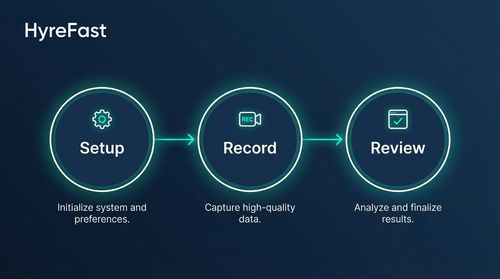
At its core, asynchronous (async) video screening is a pre-recorded interview method. Candidates respond to a fixed set of questions via video, without a live interviewer on the other end [1].
They record their answers on their own time, and hiring teams review the recordings later, at their collective convenience.
The process typically follows a clear, structured flow:
- Campaign Setup: A hiring manager defines the role and selects 3-5 structured, often behavioural or situational, questions. Each question has a recommended time limit (e.g., 2 minutes per answer).
- Candidate Interface: Candidates receive a secure link, access a browser or app-based environment-often with optional practice rounds-and record their responses.
- Asynchronous Review: Hiring team members evaluate the recordings on their own schedules. Modern platforms augment the raw video with AI-generated transcripts, keyword highlights, and timestamped notes to facilitate collaboration and faster decision-making [1].
This simple decoupling of the act of interviewing from the act of evaluation solves a profound logistical problem that has long plagued high-volume hiring.
The Driving Forces: Why Adoption in India Is Rapid and Strategic
The move to async screening in India isn’t about chasing a trend. It’s a rational, data-driven response to the unique and intense pressures of the Indian talent market.
1. Solving the Unprecedented Volume Crisis
Scale is the defining characteristic of Indian tech hiring. A single job posting for a skilled role can easily attract thousands of applications.
The math of traditional screening is brutal: manually scheduling and conducting even 15-minute live screens for just 500 applicants consumes over 125 hours of interviewer time. That’s more than three full work weeks dedicated to a single role’s initial screening [2].
Async screening collapses this timeline dramatically. A hiring manager can review 10 or more candidate videos in the time it would take to complete three live calls.
This allows companies to apply a consistent, structured initial assessment to a much larger applicant pool, ensuring that precious live-interview time is reserved only for the most promising candidates.
2. Enabling True Geographical Agnosticism
Talent is no longer confined to Tier-1 metro cities. With the sustained rise of remote and hybrid work models, companies are actively tapping into talent pools in Tier-2 and Tier-3 cities like Coimbatore, Kochi, and Ahmedabad.
Async screening removes the initial friction of coordinating live interviews across different time zones and busy schedules, making a genuinely diverse geographical hiring strategy not just aspirational but practical and efficient [2].
3. The Imperative of Cost and Time Optimisation
For growth-stage companies and startups, organisational agility is currency. Reducing time-to-hire by days and saving countless high-cost recruiter hours has a direct impact on the bottom line and the ability to outmaneuver competitors.
Industry data indicates that companies implementing async screening see a 60-70% reduction in cost-per-screen and a 40-60% reduction in time-to-hire.
In some documented cases, the recruiter time spent on screening per role dropped from 40 hours to just 8 hours [3][4]. This efficiency isn’t just a nice metric; it’s a tangible competitive advantage in a fierce market.
4. Standardisation for Fairer, More Consistent Evaluation
Unstructured early phone screens are highly vulnerable to inconsistency and unconscious bias. Different interviewers inevitably ask different questions, leading to apples-to-oranges comparisons that are neither fair nor defensible.
Async platforms enforce a standard: every single candidate answers the same questions in the same format. This structured approach significantly increases inter-rater reliability-the consistency of scoring between different evaluators-with reported improvements of 30-40% [2].This makes the evaluation process more objective, consistent, and fair.
5. Meeting Digital-Native Candidate Expectations
A large proportion of India’s workforce is young, mobile-first, and tech-savvy.
There is a strong and growing preference for seamless, digital, and self-paced processes. Counter to some initial assumptions, candidates often prefer this format.
A 2025 LinkedIn India Candidate Experience Report found that 78% of Indian candidates prefer an initial async video screen over a live phone screen [5].
The reasons are clear: it allows them to interview at their convenience, in a comfortable environment, without the anxiety of a spontaneous live call.
The Technical Backbone: More Than Just a Video Recorder
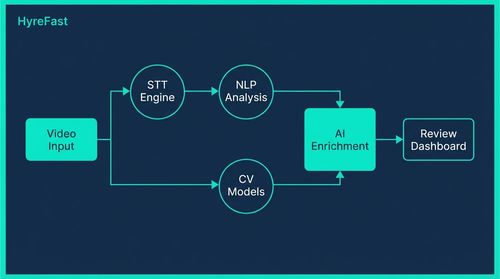
Modern async screening platforms are sophisticated systems that leverage a stack of AI technologies designed to augment human decision-making, not replace it. The research community has been actively developing and refining the models that power these systems.
- Speech-to-Text (STT) Engines: These transcribe verbal responses into searchable text. A key advancement in the Indian context is that advanced engines are now trained on diverse Indian English accents and can effectively handle code-switching (e.g., Hinglish), providing accurate transcripts for quick scanning and review.
- Natural Language Processing (NLP): This technology analyses the transcribed text to map content to specific job competencies, assess the structure of responses (e.g., automatically checking for the STAR method—Situation, Task, Action, Result), and extract relevant keywords. Research models like HireNet demonstrate how hierarchical attention models can analyze asynchronous video interviews to predict candidate hirability by examining verbal and paralanguage cues [6].
- Computer Vision (CV) Models: These are primarily used for practical, ethical checks like liveness detection (to prevent fraud) and ensuring protocol adherence. Importantly, leading platforms avoid the controversial and often biased use of emotion or sentiment analysis. Studies like "Slices of Attention in Asynchronous Video Job Interviews" explore how specific non-verbal moments can be informative, but ethical implementations focus on supporting human review rather than automated scoring based on visual cues [7].
- Collaborative Review Dashboards: The final layer presents a unified view for hiring teams, combining the video, a synchronised transcript, and AI-highlighted key moments.
This is all housed within a dashboard that allows for timestamped comments and shared evaluation, turning a solitary task into a parallel, collaborative process.
It is crucial to note that ethical implementation means these AI tools are used for enrichment and summarisation.
They help human reviewers organise information more efficiently, but the final decision remains a human one-a practice strongly cautioned for in research on algorithmic fairness to mitigate the risk of encoding historical biases [8].
Navigating Practical Challenges and Ethical Considerations
While powerful, async screening is not a silver bullet. Its success hinges on thoughtful and empathetic implementation.
- Candidate Anxiety: Speaking to a camera can feel unnatural and intimidating. This is best mitigated with transparent communication, providing unlimited practice rounds, and assuring candidates that this is a replacement for a preliminary phone screen, not the final interview.
- Bias in Automated Analysis: The risk of baking historical biases into AI models is a well-documented concern. The most robust and ethical systems use automation to support human reviewers by organising information, not to make autonomous pass/fail decisions. Continuous audits and human oversight remain non-negotiable.
- Accessibility and Equity: Not all candidates have equal access to high-speed internet, a quiet private space, or a professional setup. Offering flexibility, clear instructions, and alternative options (like audio-only or text) for those who need them is essential for building an inclusive hiring process.
Conclusion: A Structural Shift, Not Just a Trend
Async video screening has found uniquely fertile ground in India because it solves real, pressing problems: massive volume, vast geography, cost pressure, and the need for speed.
It represents more than a new tool; it's a structural shift in hiring infrastructure-a pragmatic answer to scaling the hunt for talent in one of the world's most competitive and voluminous job markets.
The companies winning with this technology are those implementing it thoughtfully within a human-centric framework. They use technology not to depersonalise hiring, but to make every subsequent live conversation more meaningful.
They ensure that valuable human interaction time is spent only with candidates who have already cleared a thoughtful, consistent, and fair first hurdle.
In doing so, they are building hiring processes that are not just faster, but also more scalable and equitable.
References
- Web Agent. "Definition and Process of Async Video Screening." 2025.
- HirePro. "Async Screening Efficiency Metrics." 2024.
- Deloitte India. "Human Capital Trends." 2025.
- Core Lit Agent. "Case Studies on Screening Efficiency." 2024.
- LinkedIn India. "Candidate Experience Report." 2025.
- Hemamou, L. et al. (2019). "HireNet: a Hierarchical Attention Model for the Automatic Analysis of Asynchronous Video Job Interviews." AAAI 2019.
- Hemamou, L. et al. (2019). "Slices of Attention in Asynchronous Video Job Interviews." ACII 2019.
- De-Arteaga, M., et al. (2023). "Fairness and Bias in Algorithmic Hiring: A Multidisciplinary Survey." arXiv:2309.13933.